Income Statement, Balance Sheet, and Cash Flow Explained
Income statement, balance sheet, and cash flow statement basics for IB interviews, with line items, timing differences, and a worked example.
On this page
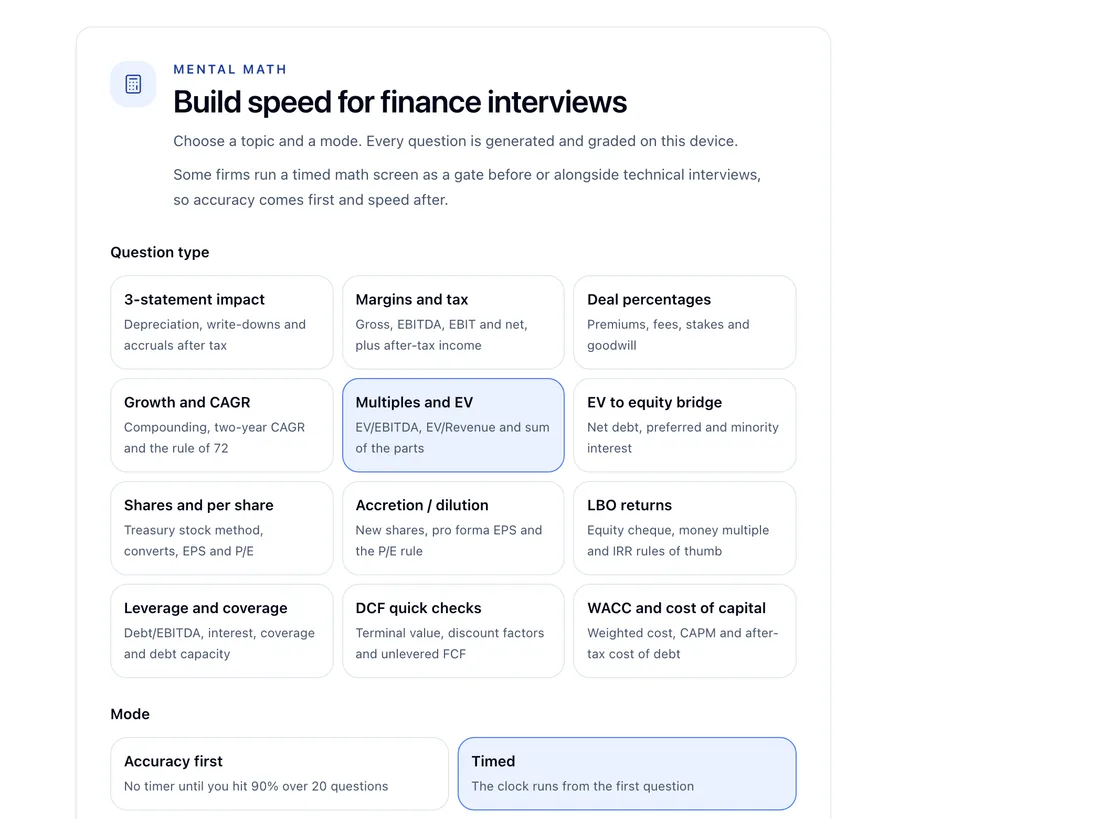
3 timed accounting questions
Start the timed setAbout 2 minutes. Free account, no card.
Round out your prep
Every banking model is built from three reports. The income statement shows profitability over a period, the balance sheet shows financial position at a point in time, and the cash flow statement explains how cash moved during the period. Corporate Finance Institute draws the same line: the income statement covers revenue and expenses, the balance sheet covers assets, liabilities, and shareholders' equity, and the cash flow statement covers cash movement. In interviews you need line-item literacy first, then the linkage. You cannot forecast unlevered free cash flow, calculate EBITDA, or answer three-statement linkage questions without knowing what each statement measures.
TL;DR
- Income statement measures performance over a period and ends with net income.
- Balance sheet is a point-in-time snapshot where assets equal liabilities plus equity.
- Cash flow statement explains cash from operating, investing, and financing activities.
- Accrual accounting means revenue and expense timing can differ from cash collection and payment.
- Try the rep beside each section, then the three-statement drill set near the end; the first rep is free.
What is the income statement?
The income statement shows revenue, expenses, and profitability over a period such as a quarter or fiscal year. It starts with revenue, subtracts cost of goods sold to reach gross profit, subtracts operating expenses to reach operating income, then subtracts interest and taxes to reach net income. CFI notes that the income statement uses matching and accrual accounting, not pure cash timing. That is why a company can report revenue before collecting cash, or record an expense before paying the bill. In investment banking, the income statement is where you usually find revenue growth, gross margin, EBITDA, EBIT, tax expense, and net income, all of which flow into valuation and credit analysis.
Accounting · try it first
Walk down the income statement from revenue to net income, naming each profit line in order.
What is the balance sheet?
The balance sheet shows what a company owns, owes, and has left for shareholders at a specific point in time. It follows one equation:
Assets include cash, accounts receivable, inventory, PP&E, goodwill, and other resources. Liabilities include accounts payable, accrued expenses, debt, deferred revenue, and other obligations. Shareholders' equity includes common stock, additional paid-in capital, and retained earnings. The balance sheet matters because it carries the accounts that drive working capital, leverage, liquidity, and book-value questions.
Accounting · try it first
A company buys 40 of inventory on credit. What changes on the balance sheet, and does it still balance?
What is the cash flow statement?
The cash flow statement reconciles accounting profit to actual cash movement. It has three sections: cash from operations, cash from investing, and cash from financing. Operating cash flow starts with net income, adds back non-cash expenses like depreciation, and adjusts for working-capital changes. Investing cash flow captures capex, acquisitions, and asset sales. Financing cash flow captures debt issuance, debt repayment, dividends, and share repurchases. The ending cash balance from this statement becomes cash on the balance sheet. This is why the cash flow statement is the bridge between income-statement profitability and balance-sheet liquidity.
| Statement | Measures | Timing | Key interview line |
|---|---|---|---|
| Income statement | Profitability | Period | Revenue to net income |
| Balance sheet | Financial position | Point in time | Assets equal liabilities plus equity |
| Cash flow statement | Cash movement | Period | Net income to ending cash |
Accounting · try it first
Net income is 50, depreciation is 10, accounts receivable rises 15, and the company spends 20 on equipment. What is operating cash flow, and where does the equipment spend land?
The accounting practice page runs a graded rep on exactly this reconciliation.
Why does the cash flow statement start with net income?
Because net income is the accrual system's final word on the period, and the cash flow statement's entire job is to reconcile that accrual profit back to real cash. The operating section is built under the indirect method: start from net income, add back the expenses that never touched cash such as depreciation, amortization, and stock-based compensation, then adjust for the working-capital movements where accrual timing diverged from cash timing. An increase in receivables means revenue was booked but not collected, so it comes out; an increase in payables means an expense was booked but not paid, so it goes back in. Net income is the only line that already contains every accrual decision, which is why it is the anchor the reconciliation starts from.
How do the three statements differ in timing?
The income statement and cash flow statement cover a period, while the balance sheet is a snapshot at one date. This timing difference is the source of many interview traps. A company can sell a product today, record revenue now, and collect cash 60 days later. The income statement sees the sale now. The balance sheet records accounts receivable until cash arrives. The cash flow statement subtracts the increase in receivables because the company has not collected cash yet. Once you understand that timing split, accrual accounting becomes a model mechanic rather than a memorized definition. The working capital versus cash flow guide goes deeper on the same gap.
How do the three statements link together?
The statements connect through five mechanical links, and interviewers grade whether you can recite them in order. First, net income flows into retained earnings on the balance sheet and also opens the operating section of the cash flow statement. Second, depreciation reduces net income, is added back on the cash flow statement, and reduces PP&E on the balance sheet. Third, working-capital changes adjust operating cash flow while moving receivables, inventory, and payables on the balance sheet. Fourth, capex sits in investing cash flow and builds PP&E on the balance sheet. Fifth, debt issuance, repayment, dividends, and buybacks run through financing cash flow and update the debt and equity accounts. The last link closes the loop: ending cash on the cash flow statement becomes the cash line on the balance sheet, which is what makes the sheet balance.
In an interview, that list is the answer to "how are the three statements connected." The worked example below is the same chain with numbers attached.
How does one sale move through all three statements?
Take a single transaction and trace it end to end. A company sells 100 dollars of product and pays 60 dollars of cost, all in cash, with no other expenses and a 25 percent tax rate. Before reading on, name the net income, the change in cash, and the change in retained earnings. Then check your answer below.
Accounting · try it first
A company sells 100 dollars of product with 60 dollars of cost, all cash, at a 25 percent tax rate. Trace net income, cash, and the balance sheet.
Can you trace one change across all three statements?
That is the whole mechanic: one event, three statements, one balancing model. The set below drills the same linkage with new numbers. The first rep is free; the practice gate appears after it. For a longer run, the three-statement practice questions article keeps going.
Practice inside this guide
Three-statement practice
Question 1 of 1
Depreciation rises by 100 on the income statement. Walk through every line it touches.
Frequently Asked Questions
Which financial statement is most important for investment banking?
All three matter, but the cash flow statement is often most important for valuation because bankers care about cash generation. The income statement supplies operating metrics, and the balance sheet supplies working capital, debt, cash, and invested capital. Interviewers test this literacy through the walk me through the financial statements prompt.
Is the income statement cash or accrual?
The income statement is accrual-based. Revenue is recognized when earned, and expenses are matched to the period they help generate revenue, even when cash collection or payment happens later.
Why must the balance sheet balance?
Because every asset is financed by either a liability or equity claim. If assets do not equal liabilities plus shareholders' equity, the model has an accounting error.
What are the three sections of the cash flow statement?
The three sections are cash from operating activities, cash from investing activities, and cash from financing activities. Together they explain the net change in cash during the period.
How does this connect to valuation?
DCF valuation starts from operating performance, adjusts for taxes, capex, depreciation, and working capital, and discounts cash flow. Comps and precedent transactions use income-statement metrics like EBITDA and net income. The walk me through a DCF guide builds the full model.
Sources
- Corporate Finance Institute, "The 3 Financial Statements": https://corporatefinanceinstitute.com/resources/accounting/three-financial-statements/ (checked September 2026)
- Wall Street Prep, "Balance Sheet": https://www.wallstreetprep.com/knowledge/balance-sheet/ (checked September 2026)
- Wall Street Prep, "Cash Flow Statement": https://www.wallstreetprep.com/knowledge/cash-flow-statement/ (checked September 2026)
Accounting practice
Practise accounting with a real grade
Take one accounting question, write the answer you would give out loud, and get a real score on it before an interviewer does.
Free, no card. 5 AI-graded reps a day for 3 days from your first rep.