IB Question Bank: How to Use 400 Questions
A practical study method for the IB question bank, the famous 400 questions investment banking guide, plus the highest-yield categories to drill first.
On this page
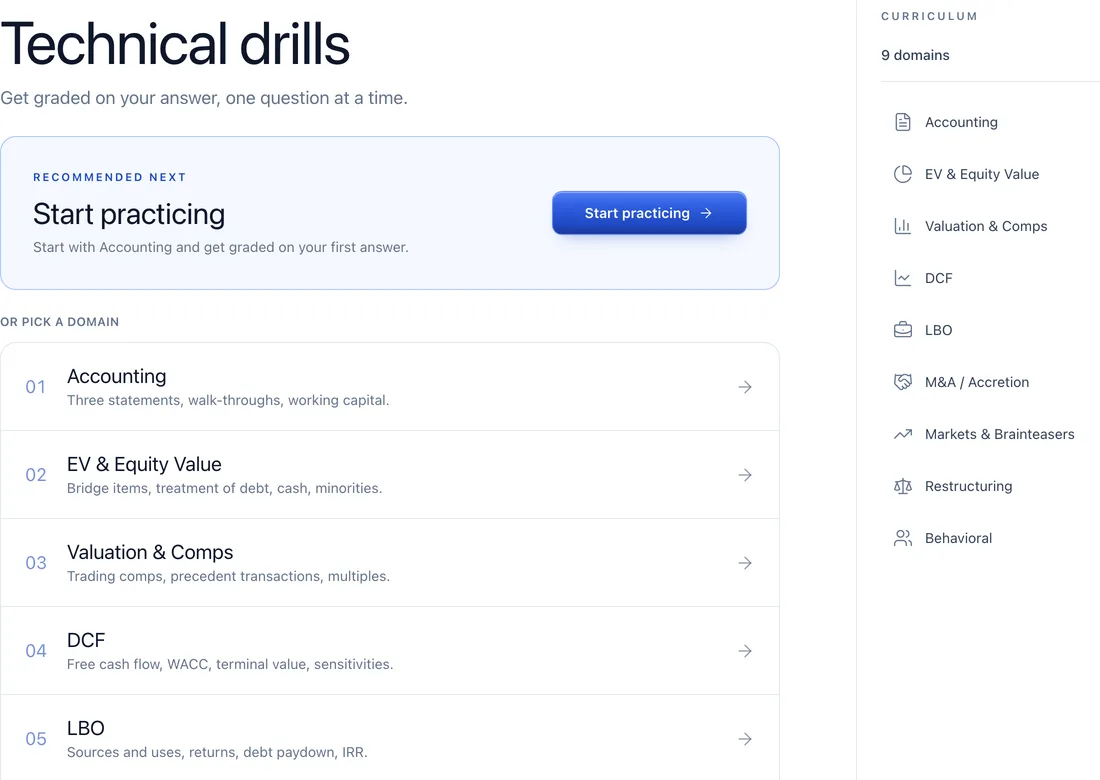
An IB question bank is a structured set of technical interview questions, usually grouped by topic, that you drill until the answers are automatic. The best known is the "400 questions investment banking" guide, a free PDF covering accounting, enterprise and equity value, valuation, DCF, and merger and LBO models. The bank itself isn't the edge. How you use it is. Reading 400 questions front to back the night before a Superday is the most common mistake candidates make. The method that actually works is spaced, topic-by-topic active recall under mock conditions, which moves answers from "I recognize that" to "I can say that out loud in fifteen seconds."
TL;DR
- The 400 questions investment banking guide covers 4 areas: accounting, valuation, DCF, and M&A or LBO modeling.
- Active recall beats re-reading: studies show 50 to 100 percent better retention than passive review.
- Drill by topic, not cover to cover. Master accounting and the 3 statements first.
- Use a 1, 3, 7, 14, 30 day spaced repetition schedule so answers stick through Superday.
- Practice out loud and timed. Recognition isn't the same as a clean 30-second spoken answer.
Want the active-recall loop without building it? Answer a public accounting question and get a free AI grade, no account needed.
Drill loop
A question bank only works when misses get recycled
Attempt cold
Answer out loud before reading notes.
Tag result
Mark clean, shaky, or blank.
Fix logic
Rewrite the reasoning, not just the wording.
Revisit
Review after 1, 3, 7, 14, and 30 days.
Mock pressure
Practice mixed topics in interview rhythm.
What is an IB question bank?
An IB question bank is a curated list of the technical questions that recur across investment banking interviews, organized so you can study one concept at a time. The classic example is Mergers and Inquisitions' 400 questions investment banking guide, which splits roughly 400 questions into basic and advanced tiers across accounting, valuation, DCF, and deal modeling. Other banks live inside Wall Street Prep, Breaking Into Wall Street, and free PDFs hosted by university career centers. The point of a bank is coverage and structure. It guarantees you've seen the question before the interviewer asks it, and it lets you track which topics you've actually mastered versus the ones you keep dodging.
How do you actually use a question bank to prep?
Use the bank as a testing tool, not a reading tool. The single highest-leverage change is to cover the answer, say your response out loud, then check it. This is active recall, and the research is blunt: students who retrieve from memory retain 50 to 100 percent more than those who re-read. Passive reading creates an illusion of familiarity that collapses the moment an interviewer is staring at you.
Build a simple loop. Pick one category, attempt every question cold, mark each as "clean," "shaky," or "blank," and only re-study the shaky and blank ones. Then space your reviews: revisit a topic after 1 day, then 3, then 7, then 14, then 30. That increasing interval is spaced repetition, and it's why a question you nailed in week one is still automatic on Superday morning. Pair the bank with curated sets like our investment banking technical interview questions and investment banking interview questions and answers so you're testing against more than one phrasing of the same concept.
Which categories should you drill first?
Drill accounting and the three statements first, because every other technical topic depends on them. If you can't explain how a 10 dollar depreciation charge flows through the income statement, balance sheet, and cash flow statement, you can't credibly answer a DCF or LBO question either. Accounting is the foundation; valuation and modeling sit on top.
After accounting, the bank's payoff is concentrated in a few recurring topics. Enterprise versus equity value, the DCF walkthrough, and the LBO walkthrough show up in nearly every interview, so they earn the most reps. For the spoken DCF answer, see walk me through a DCF; for the LBO, see walk me through an LBO. The statements themselves are covered in how the three financial statements link. Get these four cold before you touch brain teasers or niche accounting edge cases. Banks do weight them differently: the firm interview guides show which topics each bank tests hardest, so you can reorder your reps before a specific interview.
How to prioritize 400 questions by yield
Not all 400 questions carry equal interview weight. Allocate your reps by how often a topic gets asked and how much it underpins everything else.
| Category | Share of bank | Interview frequency | Drill priority |
|---|---|---|---|
| Accounting and 3 statements | High | Very high | First |
| Enterprise vs equity value | Medium | Very high | First |
| Valuation (comps, precedents) | High | High | Second |
| DCF | Medium | Very high | Second |
| M&A and LBO modeling | Medium | High | Third |
| Advanced or edge-case | Low | Low | Last |
Frontload the "first" and "second" tiers. They're the questions that, if you fumble them, end the interview. The advanced edge cases are worth a single pass for confidence, not days of drilling.
Why memorizing answers word for word backfires
Memorizing scripted answers is a trap because interviewers know the guides exist and actively avoid questions with easily memorized answers. Mergers and Inquisitions makes this point directly: bankers steer toward follow-ups and "why" questions precisely because the canned answers are everywhere. If you only memorize the surface answer, the first follow-up exposes you.
The fix is to use the bank to understand the logic, then test whether you can reason from it. When you drill "why do you use unlevered free cash flow in a DCF," don't just recite "because it's capital-structure neutral." Practice explaining the consequence: levered cash flow would force you to discount at cost of equity and rebuild the debt schedule every year. That depth is what separates a candidate who read the bank from one who understands it. Pair this with mock conditions, ideally a friend firing questions, so you rehearse the pressure, not just the content. The investment banking Superday guide covers how to hold that composure across a full round.
Practice inside this guide
Interview readiness check
Question 1 of 3
Give a one-minute answer that links your background to investment banking.
The set above is a three-rep readiness check: your story, one technical, and how you recover when a question lands wrong.
Frequently Asked Questions
What is the 400 questions investment banking guide?
It's a free PDF from Mergers and Inquisitions containing roughly 400 technical interview questions and answers, split into basic and advanced tiers across accounting, enterprise and equity value, valuation, DCF, and merger and LBO models. It's the most widely used IB question bank, mainly as a review and self-test resource.
How many questions do I really need to master?
Far fewer than 400 to a deep level. A core of about 50 to 80 questions covering accounting, the three statements, enterprise versus equity value, DCF, and LBO basics carries most interviews. Treat the rest as a confidence pass rather than memorization targets.
How far in advance should I start drilling?
Start at least 4 to 6 weeks out so spaced repetition can do its job. The 1, 3, 7, 14, 30 day review schedule needs runway. Cramming the bank in 48 hours produces recognition, not the automatic recall an interviewer's pace demands.
Should I write out answers or say them out loud?
Say them out loud. Interviews are spoken, timed, and unforgiving. Writing builds familiarity but lets you stall and edit. Speaking under a 15 to 30 second target surfaces the gaps where you understand a concept but can't actually deliver it cleanly.
Are flashcard apps useful for an IB question bank?
Yes, for the factual and definitional questions. Apps like Anki automate the spaced repetition schedule and force active recall. They're less useful for the walkthrough questions (DCF, LBO), which need spoken, structured practice rather than single-card answers.
Is the 400 questions guide still relevant?
The core technical concepts (accounting, valuation, DCF, LBO) don't change, so the fundamentals stay relevant. What changes is interviewer behavior: they probe deeper on the "why" and add follow-ups. Use the bank for the foundation, then build reasoning on top.
Sources
- Mergers & Inquisitions: 400 Questions Investment Banking (checked June 2026)
- Quizlet: 400 Investment Banking Questions, Basic Technical (checked June 2026)
- Wall Street Prep: Paper LBO and technical prep knowledge base (checked June 2026)
- Active Recall and Spaced Repetition: The Evidence, Compared (checked June 2026)
Accounting practice
Practise accounting with a real grade
Take one accounting question, write the answer you would give out loud, and get a real score on it before an interviewer does.
Free, no card. 5 AI-graded reps a day for 3 days from your first rep.