Investment Banking Technical Questions
The most common investment banking technical questions by topic: accounting, valuation, DCF, LBO, and M&A, each with a tight, interview-ready answer.
On this page
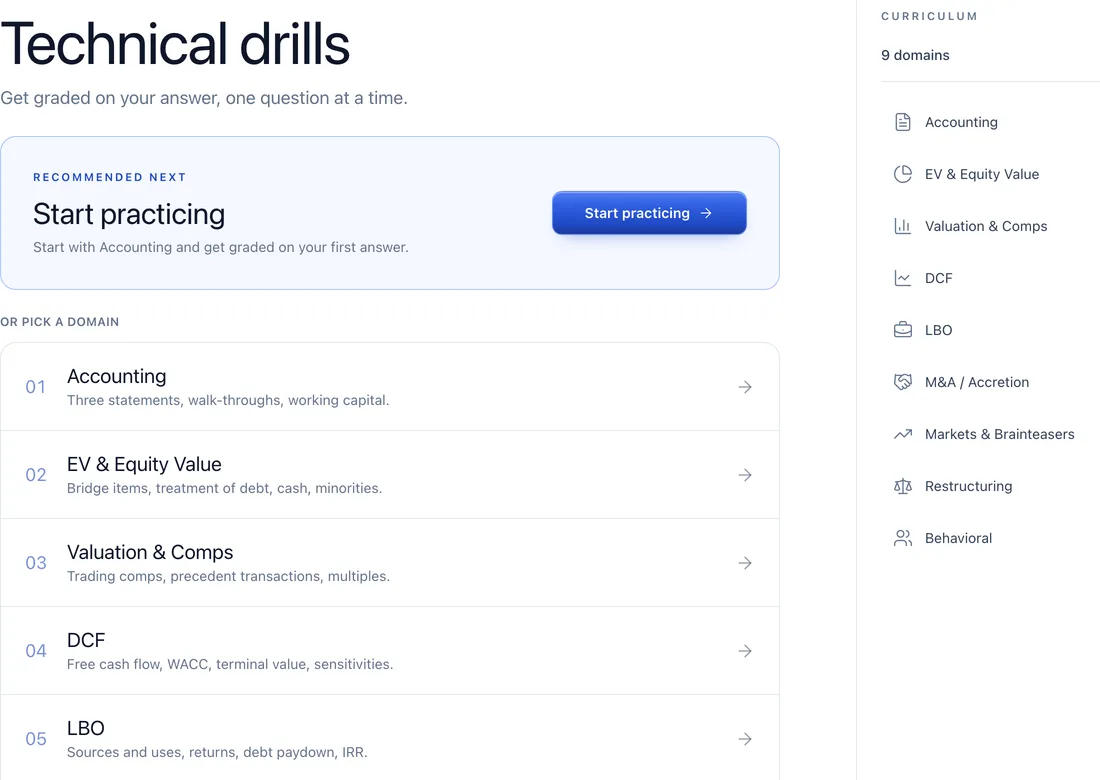
Investment banking technical questions test whether you understand accounting, valuation, and deal mechanics well enough to do the job on day one. They fall into five buckets: accounting (the three statements), valuation (comps and precedent transactions), DCF, LBO, and M&A (accretion/dilution). Wall Street Prep notes that "walk me through a DCF" is the single most common technical question, and the rest cluster around how the financial statements connect and how you value a business. This guide organizes the highest-frequency questions by topic, each with a crisp model answer, then links to deeper walkthroughs for the heaviest hitters.
TL;DR
- Technical questions split into five topics: accounting, valuation, DCF, LBO, and M&A.
- "Walk me through a DCF" is the most common single question, per Wall Street Prep.
- The three statements link through net income, which flows into both cash flow and equity.
- Valuation has two camps: intrinsic (DCF) and relative (comps, precedent transactions).
- An acquisition is accretive if pro forma EPS rises versus the acquirer's standalone EPS.
Technical map
The five topics every IB interview circles back to
Accounting
Statement links
Valuation
Comps, precedents
DCF
Intrinsic value
LBO
Sponsor returns
M&A
EPS impact
What are investment banking technical questions?
Investment banking technical questions are finance and accounting problems interviewers use to confirm you can handle the analytical core of the analyst role. They range from "light" conceptual questions in a phone screen or HireVue to harder problems in final rounds, where difficulty increases as you advance. The five core topics are accounting, valuation, DCF, LBO, and M&A. You don't need to be a markets expert; you need to know how the three statements connect, how to value a company two or three ways, and how a deal changes EPS. For a broader question bank across both technical and behavioral, see investment banking interview questions and answers.
What accounting questions get asked?
Accounting questions test whether you understand how the three financial statements connect, which is the foundation everything else rests on. The classic prompt is "how do the three statements link?" Net income from the income statement flows into the top of the cash flow statement and into retained earnings on the balance sheet. The cash flow statement reconciles to the cash line on the balance sheet, and the balance sheet must balance. A favorite follow-up: "if depreciation increases by 10 dollars, walk me through the three statements." You adjust net income for the tax shield, add depreciation back on the cash flow statement, and reduce net PP&E on the balance sheet. For the full mechanics, see the three financial statements linked.
What valuation questions get asked?
Valuation questions test whether you can value a company multiple ways and explain the tradeoffs. The core split is intrinsic versus relative: a DCF values a business on its own projected cash flows, while comparable companies and precedent transactions value it against the market. A common opener is "what are the main valuation methodologies?" Answer with the three: DCF, comparable company analysis, and precedent transactions. Expect the follow-up "which gives the highest value?" Precedent transactions usually run highest because they include a control premium paid in acquisitions. You'll also get enterprise-value-versus-equity-value questions constantly, since the distinction underlies every multiple. See enterprise value vs equity value for that bridge.
| Method | Type | Based on | Tends to give |
|---|---|---|---|
| DCF | Intrinsic | Projected cash flows | A standalone range |
| Comparable companies | Relative | Trading multiples of peers | A market-implied value |
| Precedent transactions | Relative | Multiples paid in deals | The highest, due to control premium |
What DCF questions get asked?
DCF questions are the highest-frequency technical questions in the entire process, which is why interviewers expect a fast, structured answer. The opener is always "walk me through a DCF": project unlevered free cash flow for five to ten years, discount it at WACC, calculate a terminal value, discount that back, sum to enterprise value, then subtract net debt for equity value. The follow-ups probe the assumptions: why unlevered cash flow (it's capital-structure neutral), why WACC (it matches the cash flows to all investors), and how terminal value works, which can drive roughly three-quarters of the total, per Wall Street Prep. See walk me through a DCF for the walkthrough and DCF interview questions for the full follow-up drill.
What LBO questions get asked?
LBO questions test whether you understand how a private equity firm buys a company with debt and generates returns. The opener is "walk me through an LBO": a sponsor acquires a company using mostly debt, uses the company's cash flow to pay down that debt over five years or so, and sells at exit, with returns driven by deleveraging, EBITDA growth, and multiple expansion. A frequent follow-up: "why does a higher entry multiple hurt returns?" Because you pay more upfront for the same exit, compressing your IRR. Another classic is "what makes a good LBO candidate?" Stable cash flows, low existing debt, and a clear path to deleverage. See walk me through an LBO for the full structure.
What M&A questions get asked?
M&A questions center on accretion/dilution analysis, the test of whether a deal increases or decreases the acquirer's earnings per share. A deal is accretive if pro forma post-deal EPS is greater than the acquirer's standalone EPS, and dilutive if it's lower. The standard prompt is "is this acquisition accretive or dilutive?" You compare the cost of the consideration (the yield the buyer gives up on cash, debt, or stock) against the earnings yield of the target. A quick rule: an all-stock deal is accretive when the acquirer's P/E is higher than the target's. Expect follow-ups on synergies, goodwill creation, and why a buyer might pursue a slightly dilutive deal for strategic reasons.
Practice inside this guide
Three-statement practice
Question 1 of 3
Depreciation rises by 100 on the income statement. Walk through every line it touches.
The set above turns the linkage into reps: trace a change through the statements and land on the dollar impact.
Frequently Asked Questions
How many technical questions should I prepare?
Prepare deeply across the five core topics rather than memorizing a fixed count. Master the three-statement links, two or three valuation methods, the DCF walkthrough and its follow-ups, the LBO structure, and accretion/dilution. The 400-question guides are useful breadth, but depth on these fundamentals matters more than volume. See the 400 questions investment banking guide.
Which technical question is asked most often?
"Walk me through a DCF" is the single most commonly asked technical question, per Wall Street Prep and most prep resources. It tests valuation logic, structure, and your ability to speak clearly under pressure. Have a tight ninety-second version ready, plus answers to the standard follow-ups on unlevered cash flow, WACC, and terminal value.
How technical are first-round interviews?
First-round and HireVue interviews typically ask "light" technical questions, while final rounds get harder. Early on, expect conceptual prompts like the three-statement links or the main valuation methods. Later rounds push into mechanics, edge cases, and how assumptions move the output, so the bar rises as you advance.
Do I need to memorize formulas?
You need to understand formulas, not just recite them. Interviewers care that you know why WACC discounts unlevered cash flow or why precedent transactions include a control premium. Memorizing the WACC formula without grasping the logic gets exposed the moment they ask a follow-up that changes one input.
What's the difference between technical and behavioral questions?
Technical questions test finance and accounting knowledge; behavioral questions test fit, motivation, and communication. Both matter, and a strong technical answer won't save a weak "why investment banking" response. See why investment banking for the behavioral side. Wall Street Oasis is the largest crowdsourced archive of exactly these reported questions; see how that free forum compares to AI-graded practice in IB Offer vs Wall Street Oasis.
Sources
- Wall Street Prep: Top Investment Banking Interview Questions (checked June 2026)
- Mergers & Inquisitions: Investment Banking Interview Questions and Answers (checked June 2026)
- Corporate Finance Institute: Accretion Dilution Analysis (checked June 2026)
- Wall Street Oasis: Investment Banking Interview Questions and Answers (checked June 2026)
Accounting practice
Practise accounting with a real grade
Take one accounting question, write the answer you would give out loud, and get a real score on it before an interviewer does.
Free, no card. 5 AI-graded reps a day for 3 days from your first rep.