Mental Math for Finance Interviews: Percentages
Mental math for finance interviews with fast percentages, multiples, EV-to-equity shortcuts, unit discipline, and worked IB interview drills.
On this page
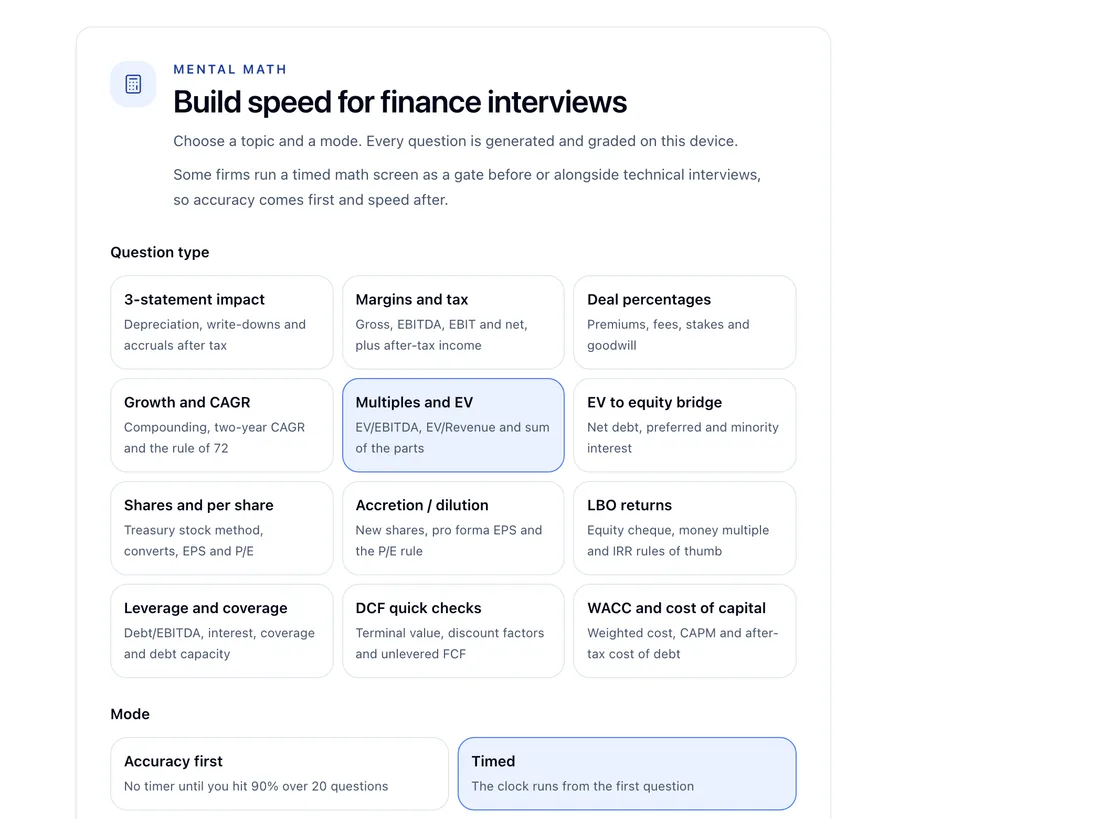
3 timed valuation multiple questions
Start the timed setAbout 2 minutes. Free account, no card.
Round out your prep
Mental math for finance interviews means calculating percentages, multiples, growth rates, margins, and valuation outputs quickly without a calculator. Investment banking interview math is rarely hard algebra. It is usually simple arithmetic under pressure: 7.5x EBITDA, 25 percent tax effect, 10 percent revenue growth, 2.0x MOIC over 5 years, or 150 basis points of margin expansion. The skill matters because bankers estimate numbers in meetings before a full model is built. This lesson splits the quick-math drills out from broader brain teasers and connects them to valuation multiples.
TL;DR
- Round first, then refine if the interviewer asks for precision.
- Convert percentages into fractions: 25 percent is one-fourth, 12.5 percent is one-eighth.
- For growth, 10 percent on 80 is 8, so the new value is 88.
- EV/EBITDA math is enterprise value divided by EBITDA, or multiple times EBITDA.
- Always say the unit: million dollars, percent, turns of leverage, or times EBITDA.
What mental math shows up in finance interviews?
The most common drills are percentage changes, margin calculations, multiples, tax effects, and per-share math. A technical interviewer may ask for enterprise value at 8.0x EBITDA on 75 million dollars of EBITDA. A behavioral interviewer may ask a quick market-sizing question. A paper LBO may require debt paydown and MOIC. The math itself is simple, but candidates lose points when they rush, drop units, or make the problem harder than it is.
What shortcuts should you know?
Use fraction equivalents for common percentages. They make mental math faster and less error-prone.
| Percentage | Fraction | Example |
|---|---|---|
| 50% | 1/2 | 50% of 80 = 40 |
| 25% | 1/4 | 25% of 80 = 20 |
| 20% | 1/5 | 20% of 80 = 16 |
| 12.5% | 1/8 | 12.5% of 80 = 10 |
| 10% | 1/10 | 10% of 80 = 8 |
Mental math
Turn common percentages into fractions you can compute instantly
For multiples, reverse the formula when needed:
If EBITDA is 75 million dollars and the multiple is 8.0x, enterprise value is 600 million dollars.
What is a worked interview drill?
Question: A company has 120 million dollars of EBITDA and trades at 9.0x EV/EBITDA. It has 300 million dollars of debt and 60 million dollars of cash. What is equity value?
First, enterprise value is 120 times 9.0, or 1,080 million dollars. Net debt is 300 minus 60, or 240 million dollars. Equity value is enterprise value minus net debt:
The answer is 840 million dollars. This is the same bridge logic covered in enterprise value bridge, just done mentally. For a timed set of ten more like it, take the mental math practice test.
How do you handle percentages under pressure?
Break percentages into easier pieces. For 17.5 percent of 200, calculate 10 percent as 20, 5 percent as 10, and 2.5 percent as 5. Total is 35. For 8 percent interest on 250 million dollars, 10 percent is 25 million dollars and 2 percent is 5 million dollars, so 8 percent is 20 million dollars. If taxes are 25 percent, after-tax interest is 75 percent of 20, or 15 million dollars. This exact shortcut appears in M&A consideration mix and accretion dilution math.
How should you speak while calculating?
Narrate the setup, then pause for arithmetic. A good answer sounds like: "I will calculate enterprise value first, then bridge to equity value. EBITDA is 120 and the multiple is 9.0x, so EV is 1,080. Net debt is 240, so equity value is 840 million dollars." That is better than silent calculation followed by a number. If you make a mistake, correct it cleanly. Interviewers are usually more forgiving of a fixed arithmetic slip than a confused structure.
Build a small daily drill set. Do 10 percentage drills, 10 multiple drills, and 5 bridge drills. Example: 12 percent of 250 is 30, 7.5x on 80 million dollars of EBITDA is 600 million dollars, and 900 million dollars of enterprise value minus 150 million dollars of net debt is 750 million dollars of equity value. The repetition matters because interview pressure makes simple math feel slower. You want the arithmetic to be automatic so the structure gets your attention. Growth questions deserve their own pass: growth rates and compounding covers the multiply-don't-add rule and the Rule of 72.
Also practice reversing formulas. If enterprise value is 600 million dollars and EBITDA is 75 million dollars, the multiple is 8.0x. If equity value is 840 million dollars and diluted shares are 42 million, share price is 20 dollars. If a 20 percent EBITDA margin produces 40 million dollars of EBITDA, revenue is 200 million dollars. Interviewers flip the usual formula to see whether you understand the relationship, not just the memorized direction. Reverse drills are especially useful for paper LBOs and quick valuation checks, and the fluency they build is what saves time under pressure.
The timed set below runs the article's chain end to end: EBITDA to enterprise value through the multiple, enterprise value to equity value through the bridge, then equity value to a share price. Each question shows the shortcut before you answer.
Quick Math
- EBITDA is $50 million and comparable companies trade at 8x. What enterprise value does that imply, in millions?
EV = EBITDA × multiple. The multiple gives enterprise value, not equity value.
- Enterprise value is $400 million and the company carries $120 million of net debt. What is the equity value, in millions?
Equity value = EV − net debt. Going down from EV to equity, flip the signs.
- Equity value is $280 million and 40 million shares are outstanding. What is the implied price per share?
Price = equity value ÷ shares outstanding.
Frequently Asked Questions
Do investment banking interviews allow calculators?
Usually no for verbal technical questions and paper LBOs. Some modeling tests allow Excel, but mental math still matters for explaining outputs and checking reasonableness.
What math should I practice first?
Practice percentages, margins, multiples, enterprise value to equity value, tax-effected interest, and IRR or MOIC shortcuts.
How precise do answers need to be?
Use exact math when the numbers are easy. If numbers are messy, round clearly and say you are estimating. Structure matters more than false precision.
What is the fastest way to calculate a margin?
Margin equals profit divided by revenue. If EBITDA is 30 million dollars on 150 million dollars of revenue, EBITDA margin is 20 percent.
How do I avoid unit mistakes?
Say units after each output. "600 million dollars of enterprise value" is clearer than "600." For leverage, say "4.0x Debt/EBITDA," not "4."
Sources
- Mergers & Inquisitions, "Investment Banking Interview Questions and Answers": https://mergersandinquisitions.com/investment-banking-interview-questions-and-answers/ (checked July 2026)
- Corporate Finance Institute, "EV/EBITDA": https://corporatefinanceinstitute.com/resources/valuation/ev-ebitda/ (checked July 2026)
Valuation practice
Practise valuation with a real grade
Take one valuation question, write the answer you would give out loud, and get a real score on it before an interviewer does.
Free, no card. 5 AI-graded reps a day for 3 days from your first rep.