Market Sizing Questions and Answers for IB Interviews
Practice finance market sizing questions with structures, worked answers, clean math, and sanity checks for investment banking interviews.
On this page
Market sizing questions in investment banking interviews test whether you can define a market, break it into drivers, calculate with limited data, and explain whether the result makes business sense. A strong answer clarifies scope, states one equation, uses round assumptions, shows units, and sanity-checks the output. The goal is not to guess the exact market size.
TL;DR
- Clarify geography, customer, unit, and time period first.
- Pick top-down, bottom-up, capacity-based, or replacement-cycle logic.
- State the equation before inserting assumptions.
- Keep units visible and use round numbers.
- Finish with a second method or a per-customer sanity check.
What structure should you use?
Use this five-step loop for every question:
- Define what is included and excluded.
- Choose a driver tree.
- State assumptions before calculating.
- Compute in visible steps with units.
- Sanity-check and identify the most sensitive assumption.
| Method | Core equation | Best finance use |
|---|---|---|
| Top-down | Population x penetration x frequency x price | Consumer TAM |
| Bottom-up | Customers x units per customer x price | Fintech or SaaS revenue pool |
| Capacity | Locations x capacity x utilization x price | Airlines, healthcare, data centers |
| Replacement cycle | Installed base / useful life x price | Devices, vehicles, equipment |
For the full framework, read market sizing and estimation frameworks.
How would you size the US wealth management market?
Clarify that the question asks for annual advisory revenue, not assets under management. Use a top-down approach.
Assume 130 million households, 20 percent with investable assets suitable for advice, average managed assets of 500,000 dollars, and an average fee of 0.8 percent.
The estimate is about 104 billion dollars of annual advisory revenue. Sanity-check it as 26 million advised households paying about 4,000 dollars each per year. The most sensitive assumptions are eligible household penetration and average assets.
How would you size a payments processor's revenue pool?
Use merchant payment volume times processor take rate. Assume 2 trillion dollars of addressable payment volume and a 0.25 percent net take rate.
The annual revenue pool is about 5 billion dollars. Clarify whether the take rate is gross merchant discount revenue or net revenue after network and interchange costs. That distinction can change the answer materially.
How would you size data-center demand?
Use capacity rather than population. Assume 250 facilities in the target region, average critical capacity of 20 megawatts, 80 percent utilization, and annual revenue of 1.5 million dollars per utilized megawatt.
The revenue market is about 6 billion dollars. Cross-check the answer against total utilized capacity of 4,000 megawatts. In a real pitch book, you would separate hyperscale, colocation, and enterprise facilities because pricing and utilization differ.
How would you size the private credit fee pool?
Define the market as annual management fees on private-credit assets, excluding carried interest. Assume 1.5 trillion dollars of assets and an average management fee of 1 percent.
The estimated annual management-fee pool is 15 billion dollars. A better answer would segment direct lending, distressed, real-estate debt, and specialty finance rather than assume one fee across all strategies.
What other questions should you practice?
| Question | Suggested structure | Sanity check |
|---|---|---|
| Annual US airline baggage-fee revenue | Passengers x checked-bag rate x bags x fee | Fee revenue per passenger |
| European SaaS payroll market | Employers x employees per employer x price per employee | Revenue per employer |
| Oncology clinic capacity | Clinics x chairs x sessions x utilization | Patients per clinic per day |
| Consumer lending originations | Adults x borrower penetration x loans x average balance | Debt per borrower |
| M&A buyer universe for a software target | Strategic segments + sponsor screen | Named buyers per segment |
| TAM for a new finance app | Target users x paid penetration x annual price | Implied conversion and spend |
The buyer-universe question is not a pure revenue TAM. The same logic still applies: define screening criteria, segment the population, estimate each segment, and remove overlaps. Link the result back to strategic rationale in M&A.
What makes an interview answer strong?
Strong answers are easy to interrupt and audit. The interviewer can see the equation, units, and next step at any moment. State uncertainty directly: "I will assume 20 percent penetration and test 15 to 25 percent at the end." That sounds more commercial than pretending an estimate is precise.
Do not bury arithmetic in narration. Write the driver tree, calculate one branch at a time, and summarize the result in a sentence. For faster calculations, use the finance mental math guide and banking brain teasers.
Use these fresh scenarios to practise the full loop, from a scoped driver tree to a sensitivity and a second-metric check.
Practice inside this guide
Market sizing practice
Question 1 of 1
A provider in a fictional province may sell annual home-energy assessments. With no figures supplied, outline an assumption-driven estimate of annual addressable revenue. Define scope, show the driver tree and units, give a range, and name a sanity check rather than asserting a sourced market total.
Frequently Asked Questions
Do investment banks ask market sizing questions?
They can, especially when testing commercial judgment, mental math, or market awareness. The format is less central than in consulting, but the reasoning maps directly to pitch books, TAM analysis, and deal discussions.
How accurate should the answer be?
Directionally reasonable is enough if the structure, assumptions, math, and sanity check are clear. A defendable range is often better than false precision.
Should I use top-down or bottom-up?
Use the method that matches the available drivers. Population and user questions suit top-down logic. Store, asset, transaction, and capacity questions often suit bottom-up logic.
What if I do not know an assumption?
Choose a round assumption, state why it is plausible, and show how the answer changes if it moves. Interviewers are judging your reasoning, not your private database.
How should I finish the answer?
State the result, define its units, give a quick sanity check, and name the assumption that matters most. Then connect the market size to the business or transaction decision.
Sources
- Wall Street Prep: Market Sizing Questions (checked July 2026)
- Road to Offer: Market Sizing Questions (checked July 2026)
- IGotAnOffer: Market Sizing Questions (checked July 2026)
- Hacking the Case Interview: Market Sizing (checked July 2026)
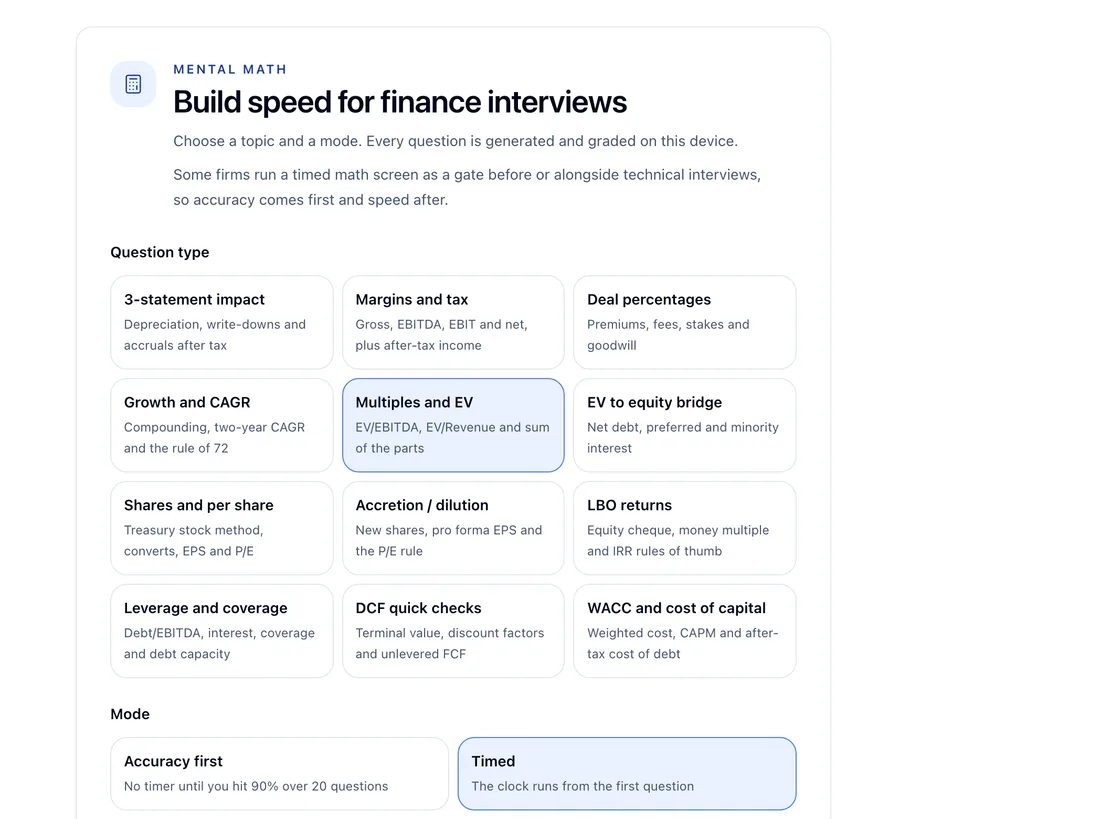
Mental Math
Practise this under time pressure
Speed is the part reading cannot teach. Run a timed set and see where the seconds actually go.
Free, no card. 5 AI-graded reps a day for 3 days from your first rep.