Markets Awareness: Rates, Credit Spreads, Macro
Markets awareness for IB interviews: rates, credit spreads, inflation, equity markets, and how to discuss macro without pretending certainty.
On this page
Markets awareness means explaining how rates, credit spreads, inflation, equity markets, and recent macro news affect companies, valuation, and deal activity. Interviewers are not looking for a hedge-fund macro call. They want to know whether you follow markets enough to connect current conditions to financing costs, M&A appetite, IPO windows, and valuation multiples. A good answer has 3 parts: what happened, why it matters, and how it affects clients. This lesson complements stock pitch, capital markets vs investment banking, and debt capital markets.
TL;DR
- Higher rates usually reduce valuation by raising discount rates and debt costs.
- Wider credit spreads make leveraged finance and LBOs more expensive.
- Strong equity markets can reopen IPO and follow-on issuance windows.
- Inflation affects margins, pricing power, and central-bank policy expectations.
- Use a 3-part answer: event, business impact, client implication.
What does markets awareness mean in IB interviews?
Markets awareness translates financial news into banking relevance. If rates rise, do not stop at "bonds went down." Explain that higher risk-free rates can raise WACC, pressure DCF valuations, increase debt interest expense, and reduce sponsor LBO capacity. If credit spreads widen, borrowers pay more above benchmark rates, so high-yield issuance, acquisition financing, and dividend recap activity may slow. If equity indices rally and volatility falls, IPO candidates may revisit issuance plans. The interviewer wants commercial reasoning, not a memorized headline.
Which market indicators should you track?
Track a small set well instead of pretending to follow everything. The most useful indicators for IB candidates are policy rates, Treasury yields, credit spreads, major equity indices, volatility, inflation data, and sector-specific news for groups you target.
| Indicator | Why bankers care | Interview angle |
|---|---|---|
| Treasury yields | Discount rates and debt costs | Valuation and financing |
| Credit spreads | Borrower risk premium | Leveraged finance appetite |
| Equity indices | Investor risk appetite | IPO and follow-on windows |
| Volatility | Execution risk | Timing of offerings |
| Inflation | Margins and rates | Pricing power and policy |
How do rates affect valuation?
Rates affect valuation through discount rates and financing costs. In a DCF, higher risk-free rates usually raise cost of equity and WACC, lowering the present value of cash flows. The simplified WACC formula is:
If the risk-free rate rises, cost of equity often rises through CAPM, and debt cost usually rises as companies refinance. This connects directly to cost of equity and cost of debt and DCF sensitivity.
Rates and valuation
Higher rates push discount rates up and valuation down
What is a worked macro-to-deal example?
Suppose a sponsor is evaluating an LBO with 400 million dollars of debt. If the interest rate moves from 7 percent to 9 percent, annual interest expense rises by 8 million dollars:
At a 25 percent tax rate, after-tax interest cost rises by 6 million dollars. That reduces free cash flow available for debt paydown, lowers exit equity value, and can reduce IRR. The candidate answer should say: higher rates make financing more expensive, reduce debt capacity, and can pressure purchase prices, especially in sponsor-backed deals.
How should you answer a current-events question?
Use a repeatable structure. First, name the event in one sentence. Second, explain the mechanism. Third, connect it to clients or transactions. Example: "Rates moved higher after stronger inflation data. That matters because higher rates raise WACC and debt costs, which can pressure valuation and reduce LBO debt capacity. For banking clients, it may affect sale timing, refinancing decisions, and whether an IPO or debt issuance is attractive right now." This answer is useful even if you do not make a market prediction.
Pick one market story and follow it for several days before interviews. For example, if rates are moving, know whether the move came from inflation, labor data, central-bank language, or Treasury supply. Then connect that story to 2 groups: sponsor M&A and debt capital markets. This avoids the shallow "markets are volatile" answer and gives you a practical way to discuss client decisions.
Keep the tone humble. Do not pretend to know the Fed's next decision or the exact path of credit spreads. A stronger answer says, "If rates stay higher, I would expect more focus on refinancing risk and less aggressive leverage in sponsor deals." That is conditional, useful, and tied to banking work. The same pattern works for IPO windows, M&A volumes, and refinancing activity: name the condition, then name the client decision it changes. Clear conditional reasoning beats macro bravado.
Practice inside this guide
Markets awareness practice
Question 1 of 1
In a hypothetical week, government bond yields rise after an inflation surprise while credit spreads on a fictional issuer's bonds widen. In a concise interview answer, separate the benchmark-rate move from the spread move, explain one issuer or investor implication, and name the key uncertainty.
The self-check set below practices the rates, spreads, and concise-view reasoning in this guide.
Frequently Asked Questions
Do I need to predict where rates are going?
No. You need to explain the impact of rate moves. It is safer to discuss scenarios than to make a confident macro forecast.
What are credit spreads?
Credit spreads are the extra yield borrowers pay above a benchmark rate to compensate lenders for credit risk. Wider spreads mean financing is more expensive.
How do equity markets affect IPOs?
Strong equity markets and lower volatility can improve IPO receptivity because investors are more willing to buy new issues. Weak markets can delay offerings.
How often should I read market news before interviews?
Read a concise market summary daily during recruiting and go deeper on 2 or 3 stories that connect to your target groups.
What if the interviewer asks about a market I do not know?
State what you know, reason from first principles, and avoid inventing facts. A clear mechanism beats a fabricated data point.
Sources
- Corporate Finance Institute, "Credit Spread": https://corporatefinanceinstitute.com/resources/fixed-income/credit-spread/ (checked July 2026)
- Corporate Finance Institute, "Weighted Average Cost of Capital": https://corporatefinanceinstitute.com/resources/valuation/what-is-wacc-formula/ (checked July 2026)
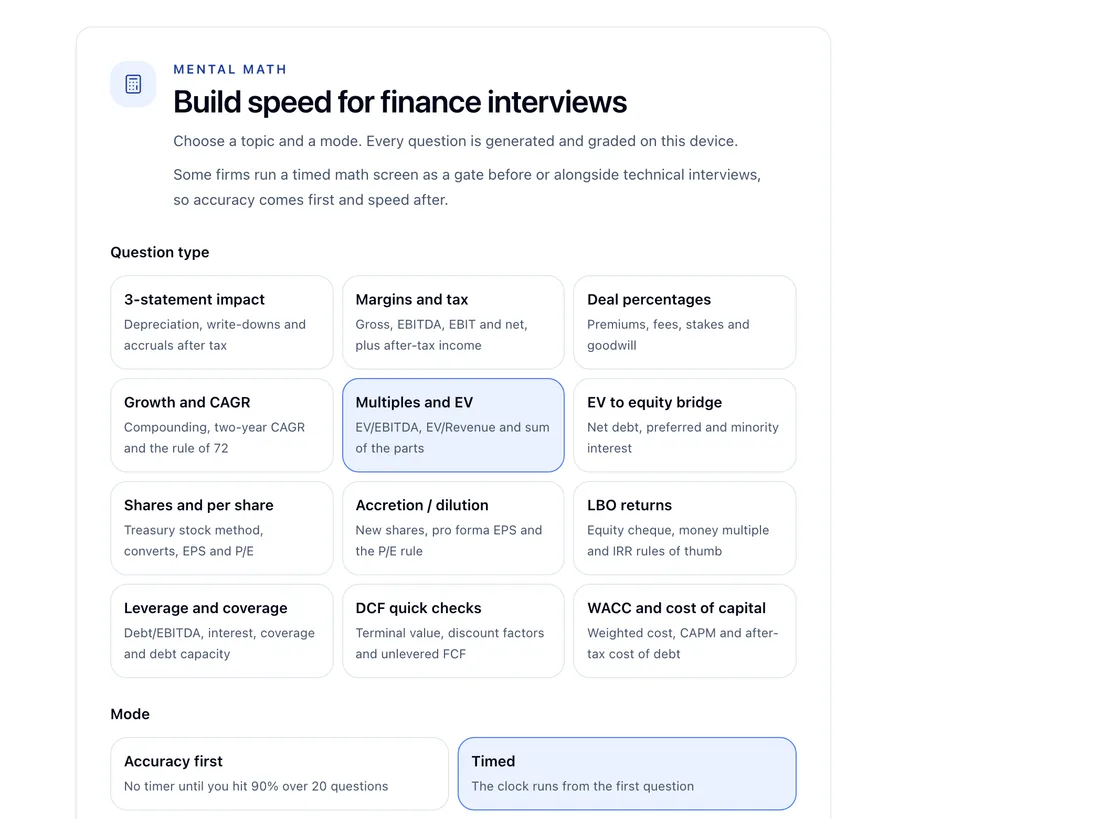
Mental Math
Practise this under time pressure
Speed is the part reading cannot teach. Run a timed set and see where the seconds actually go.
Free, no card. 5 AI-graded reps a day for 3 days from your first rep.