Debt Capital Markets (DCM): What It Does
Debt capital markets (DCM) explained: investment-grade bond issuance, credit ratings, the analyst role, and how DCM differs from LevFin and ECM in banking.
On this page
Debt capital markets (DCM) is the product group inside an investment bank that helps companies and governments raise money by issuing debt, mainly investment-grade corporate bonds. Instead of selling ownership, the issuer borrows from investors and repays the principal at maturity with interest along the way. Wall Street Prep defines DCM as "a product group within the investment banking division that offers capital raising services in the form of corporate bonds and government bonds on behalf of their clients." Its core focus, per WSP, is "the issuance of investment-grade bonds syndicated and sold to institutional investors." DCM is higher-volume and lower-margin than equity work, the modeling is light, and it sits between sales and trading and traditional banking. This guide covers what DCM does, the analyst role, and how it compares to LevFin and ECM.
TL;DR
- DCM raises debt by issuing investment-grade corporate and government bonds for everyday corporate purposes.
- Wall Street Prep: DCM's core focus is "investment-grade bonds syndicated and sold to institutional investors."
- DCM differs from Leveraged Finance, which handles high-yield debt for LBOs and acquisitions.
- Credit ratings from S&P, Moody's, and Fitch determine whether an issuance is investment-grade or high-yield.
- M&I cites DCM hours near market hours (roughly 12 per day) with minimal financial modeling.
What is debt capital markets (DCM)?
Debt capital markets is the team that advises companies, sovereigns, agencies, and supra-nationals on raising money through debt securities rather than equity. The issuer borrows from bond investors, pays interest (the coupon) over the life of the bond, and repays the full principal at maturity. Mergers & Inquisitions describes a DCM as "a market in which companies and governments raise funds through the trade of debt securities, including corporate bonds, government bonds," and so on.
DCM's specialty is investment-grade debt: bonds from financially solid issuers raising money for general corporate purposes, working capital, or refinancing. M&I notes the work is a "higher-volume, lower-margin business" with rapid timelines measured in days rather than the weeks or months of an M&A deal. Like ECM, it is "a cross between sales & trading and investment banking," a hybrid our capital markets versus investment banking guide maps in full. The equity-side counterpart is equity capital markets (ECM), which raises money by selling stock instead of bonds.
How do interviewers test DCM candidates?
DCM interviews lean on credit and capital-structure judgment more than free-form modeling, since the job is issuance and market execution rather than building projections from scratch. Expect questions on why a company would choose bonds over a loan, how a credit rating changes pricing, and how a capital structure holds up under stress, the same reasoning a restructuring banker applies from the other side of a distressed situation.
The restructuring interview questions pack is the closest existing technical rep for that reasoning: it drills fulcrum securities, DIP financing, and Chapter 11 versus Chapter 7, the capital-structure logic DCM interviewers probe from the healthy side of the balance sheet. Run it before a DCM interview, then work through coverage ratio versus leverage ratio for the lender-side math most credit questions reduce to.
LBO · try it first
A CFO asks the DCM team: how much additional debt can we raise before the rating agencies take our investment-grade rating away? Walk through what the banker checks before answering.
How does DCM differ from leveraged finance?
DCM and leveraged finance both raise debt, but they sit at opposite ends of the credit spectrum. DCM handles investment-grade issuances: lower-risk, lower-yield bonds used for routine corporate needs. Our investment-grade versus high-yield guide draws the rating cutoff and its pricing consequences in full. Leveraged finance (LevFin) handles non-investment-grade, higher-yield debt, the high-yield bonds and syndicated leveraged loans used to fund acquisitions, leveraged buyouts, and recapitalizations. The split is about the borrower's credit quality and the purpose of the money.
That distinction drives the day-to-day. Because investment-grade issuances are so standardized, M&I says "you do little financial modeling in many DCM groups." LevFin, by contrast, builds detailed LBO and credit models because the deals are riskier and tied to transactions. The purpose differs too: DCM money funds everyday business, while LevFin money funds buyouts and M&A. That is also why LevFin is the stronger feeder into private equity. If you want the mechanics of how debt powers a buyout, our walk me through an LBO guide breaks down the structure.
| Dimension | DCM | Leveraged Finance |
|---|---|---|
| Credit quality | Investment-grade | Non-investment-grade (high-yield) |
| Typical purpose | General corporate, refinancing | Acquisitions, LBOs, recaps |
| Yield / risk | Lower | Higher |
| Modeling intensity | Minimal | Heavy (LBO and credit models) |
| PE exit strength | Weak | Strong |
Behavioral · try it first
Three mandates land on the desk on Monday: a utility refinancing investment-grade bonds, high-yield notes funding a sponsor's buyout of a retailer, and a convertible for a listed software company. Which desk runs each, and what rule separates them?
Practice inside this guide
Paper LBO practice
Question 1 of 1
Walk through a paper LBO: entry at 8x EBITDA of 50, 4x leverage, and exit at the same multiple after five years.
What role do credit ratings play in DCM?
Credit ratings are central to DCM because they decide whether a bond is investment-grade (DCM's domain) or high-yield (LevFin's). Wall Street Prep notes analysts evaluate credit ratings from S&P, Moody's, and Fitch alongside debt sizing, maturity length, and market liquidity. A higher rating means lower perceived default risk, which means a lower coupon the issuer has to pay.
Ratings flow into pricing directly. WSP lists the yield or coupon as a function of "credit quality of borrower, market supply/demand, comparables, market interest rate," and notes that shorter maturities carry less risk while longer maturities carry more. So a DCM banker advising on an issuance is constantly weighing the issuer's rating against current market rates and recent comparable deals to land the right structure and price. This credit lens is why DCM exits skew toward treasury, corporate banking, credit rating agencies, and fixed-income research rather than equity-focused roles.
Valuation · try it first
An investment-grade bond was issued at par with a 5 percent coupon. A year later the issuer is downgraded and the market now demands a 6 percent yield. What happens to the bond's price, and what does it mean for the issuer's next deal?
Quick Math
- A bond pays a $6 coupon and trades at $80. What is its current yield, in percent?
Current yield = coupon ÷ price, not the coupon rate.
- EBITDA is $120 million and interest expense is $30 million. What is interest coverage, as a multiple?
Coverage = EBITDA ÷ interest.
- At a 10% discount rate, roughly what is $100 million received in 2 years worth today, in millions?
The 2-year discount factor at 10% is 1 ÷ 1.1², about 0.83.
What does a DCM analyst actually do?
A DCM analyst splits time between client advisory, deal execution, and support work, with little of the heavy modeling found in coverage or LevFin groups. On advisory, the analyst answers refinancing questions and recommends debt structures. On execution, the analyst drafts memos for internal committees and sales teams to get the deal approved and sold. Support work means market update slides, case studies, and responses to requests from other groups.
The analyst also has to know bond mechanics cold, and our bond issuance guide walks the full chain from mandate through bookbuilding to settlement. M&I lists the deal terms analysts work with: principal amount, coupon (fixed or floating), maturity date, payment frequency (typically semiannual for corporate bonds), seniority in the capital structure, call and redemption provisions, covenants, and original issue discount. M&I puts DCM hours "close to market hours," roughly 12 a day, though they "can approach the traditional IB grind" when deals are live and drop to updating slides on quiet days. For the broader interview prep that still applies, see our investment banking technical interview questions hub.
Behavioral · try it first
A summer analyst loved following rates and new-issue markets, disliked building models from scratch, and wants an exit into corporate treasury or a rating agency. DCM, ECM, or M&A coverage, and what is the trade-off?
How does DCM compare to ECM?
DCM and ECM are the two capital-markets product groups, and they mirror each other: DCM raises debt, ECM raises equity. Both originate deals like coverage teams and execute against live markets like sales and trading, both run lighter modeling than M&A, and both offer better hours than coverage groups. The difference is the instrument. DCM issuers borrow and repay; ECM issuers sell ownership.
Their exit profiles differ in a useful way. M&I notes DCM offers "broader exit opportunities than ECM," with credit skills that transfer to treasury, corporate banking, rating agencies, and fixed-income research. Both groups, however, are weak feeders into private equity, because PE recruits on M&A and LBO experience neither accumulates. M&I is blunt that DCM is "still not an ideal group for getting into private equity." When choosing between the two, the deciding question is usually debt versus equity interest, and our investment banking groups explained guide maps where each group sits inside the bank. See equity capital markets (ECM) for the equity side in full.
Frequently Asked Questions
What is the difference between DCM and leveraged finance?
DCM handles investment-grade debt (lower-risk bonds for everyday corporate needs), while leveraged finance handles non-investment-grade, high-yield debt used for LBOs and acquisitions. DCM does minimal modeling because investment-grade deals are standardized; LevFin builds detailed LBO and credit models. LevFin is the stronger path into private equity for that reason.
What is the difference between DCM and ECM?
DCM raises debt through bond issuance; ECM raises equity through IPOs, follow-ons, and convertibles. Both are capital-markets product groups that originate and execute against live markets. M&I notes DCM has "broader exit opportunities than ECM" thanks to transferable credit skills. See our equity capital markets (ECM) guide for the equity side.
Is DCM a good group for private equity?
No. M&I states DCM is "still not an ideal group for getting into private equity." PE firms use debt to fund transactions, but most DCM issuances are not M&A or LBO related, so analysts lack the deal-modeling reps PE recruits for. Stronger DCM exits are treasury, corporate banking, credit rating agencies, and fixed-income research.
What do you do little of in DCM?
Financial modeling. M&I says "you do little financial modeling in many DCM groups because investment-grade issuances are so straightforward." The work is higher-volume and lower-margin, focused on structuring, pricing against comparables, drafting memos, and bond mechanics rather than building three-statement or LBO models.
What are the hours like in DCM?
Close to market hours, roughly 12 a day per M&I, with a culture between sales and trading and investment banking. On a quiet day with no live deals, the work might just be updating market slides. When deals are live, the hours "can approach the traditional IB grind," so it is better than coverage on average but not a guaranteed easy schedule.
What bond terms does a DCM analyst need to know?
The core deal terms per M&I: principal amount, coupon (fixed or floating), maturity date, payment frequency (typically semiannual for corporate bonds), seniority in the capital structure, call and redemption provisions, covenants, and original issue discount. Analysts also track yield to maturity and yield to worst and how each term affects the bond's price and risk.
Sources
- Mergers & Inquisitions: Debt Capital Markets (DCM) (checked June 2026)
- Wall Street Prep: Debt Capital Markets (DCM) (checked June 2026)
- Mergers & Inquisitions: Equity Capital Markets (ECM) (checked June 2026)
- J.P. Morgan: Debt Capital Markets (checked June 2026)
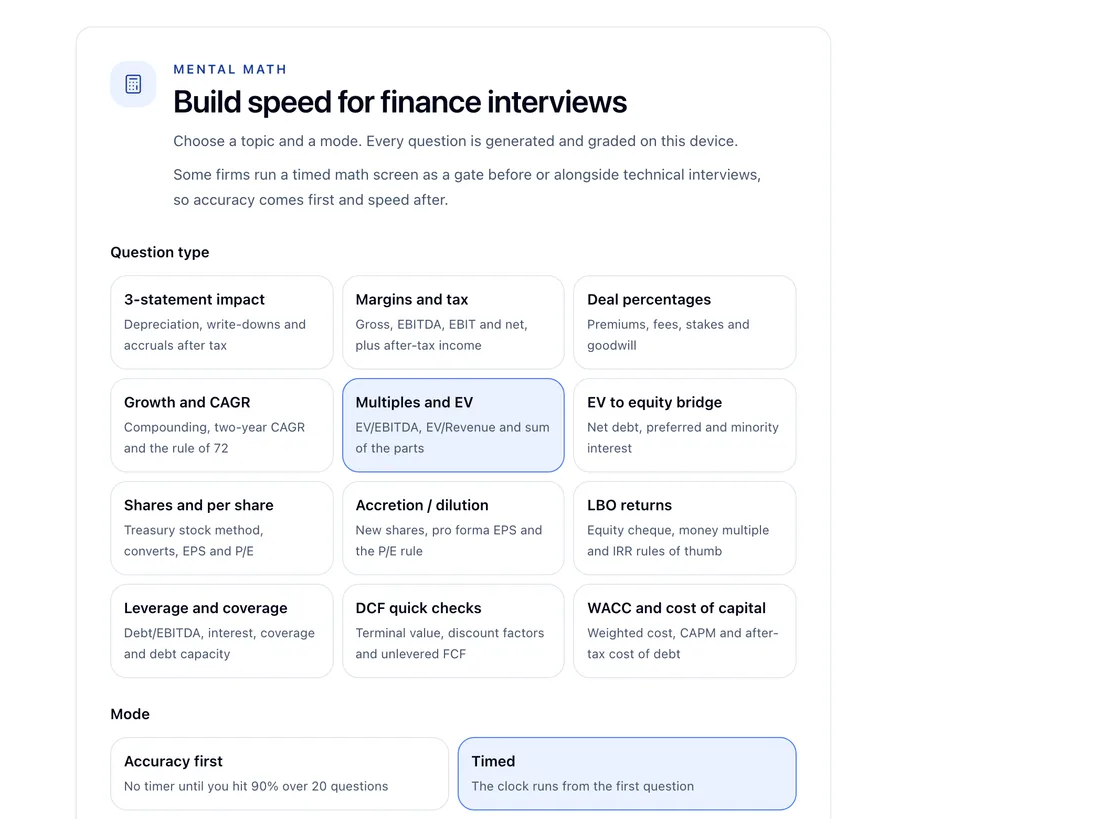
Mental Math
Practise this under time pressure
Speed is the part reading cannot teach. Run a timed set and see where the seconds actually go.
Free, no card. 5 AI-graded reps a day for 3 days from your first rep.