Equity Capital Markets (ECM): What It Does
Equity capital markets (ECM) explained: IPOs, follow-ons, convertibles, block trades, the analyst role, ECM vs M&A, and what to know for ECM interviews.
On this page
Equity capital markets (ECM) is the product group inside an investment bank that helps companies raise money by selling ownership: IPOs, follow-on offerings, convertible bonds, and block trades. When a company wants cash and is willing to sell a stake instead of borrowing, ECM runs the deal. Mergers & Inquisitions describes ECM as "a cross between investment banking and sales & trading," because the team originates deals like a coverage group but executes and prices them against live markets. ECM splits into subgroups (Origination, Syndicate, and often Equity-Linked), the work is more qualitative than M&A modeling, and the hours are usually better. This guide covers what ECM does, the analyst role, and how it differs from traditional advisory banking.
TL;DR
- ECM raises equity capital through IPOs, follow-ons, convertibles, block trades, and rights offerings.
- Mergers & Inquisitions calls ECM "a cross between investment banking and sales & trading."
- ECM divides into 3 to 4 subgroups: Origination, Syndicate, Equity-Linked, sometimes Private Placements.
- CFI notes most banks run ECM as a joint venture with the coverage division, splitting fees roughly 50/50.
- Hours are better than M&A (M&I cites a typical 7 AM to 7 PM day), but private equity exits are hard.
What is equity capital markets (ECM)?
Equity capital markets is the team that advises companies on raising capital by issuing stock, rather than borrowing. The company sells a percentage of ownership in exchange for cash, and ECM structures, prices, and places that offering with investors. Corporate Finance Institute defines ECM bankers as professionals who "help corporate stock issuers plan and execute equity offerings, providing guidance on raising new capital and managing outstanding equity."
ECM sits between two worlds. It originates deals like a coverage group, pitching companies on when and how to raise equity, but executes against live markets like sales and trading, tracking the share price and investor demand in real time. The work is less about deep DCF models and more about market reads, investor targeting, and timing. For the bigger map of where capital-markets desks sit inside the bank, see capital markets vs investment banking. The debt-side equivalent is debt capital markets (DCM), which raises money through bonds instead of stock.
What products does ECM work on?
ECM handles every way a company raises or manages public equity. The flagship product is the IPO, which takes a private company public for the first time. Our IPO process guide walks all five stages from underwriter selection through the quiet period. After that, follow-on offerings let already-public companies raise more equity, and these are faster and easier to execute because investors already know the issuer. Convertible bonds, block trades, and rights offerings round out the menu.
Each product carries a different difficulty and fee profile. M&I notes follow-ons "tend to keep ECM teams afloat" between IPOs and carry lower fees because the issuer is already known. Convertible bonds are hybrids: they start as interest-bearing debt but convert to equity if the share price crosses a set level, so the convertible desk does the most quantitative work in ECM. Block trades involve the bank buying a large stock position onto its own balance sheet and reselling it.
| Product | What it is | Relative complexity |
|---|---|---|
| IPO | First sale of stock to the public | Highest; most profitable |
| Follow-on offering | A listed company raises more equity | Lower; issuer already known |
| Convertible bond | Debt that converts to equity at a set price | High; quantitative |
| Block trade | Bank buys and resells a large share block | Execution-heavy |
| Rights offering | New shares offered to existing holders | Moderate |
Pricing a new issue runs off trading comparables rather than a standalone DCF. ECM builds a comp set of listed peers, applies the multiples where those names trade to the issuer's revenue or EBITDA, and backs into an implied valuation range and offer price:
Our comparable company analysis guide covers the comp-set build in detail, and EV/EBITDA and valuation multiples covers which multiple fits which type of issuer. Syndicate then tests that range against live investor demand during bookbuilding, so the final offer price reflects both where comparables trade and what the order book will actually pay. You can drill the mechanics on our valuation comps practice page.
Valuation · try it first
A software company with 300 million dollars of revenue is going public, and listed peers trade at a median of 8x EV/Revenue. How does ECM turn that into an IPO price range?
Practice inside this guide
Valuation multiples practice
Question 1 of 1
Two companies have similar revenue but trade at different EV/EBITDA multiples. What explains the gap?
What does an ECM analyst actually do?
An ECM analyst spends most of the day on market-facing deliverables, not on three-statement models. Typical work includes equity market update slides, case studies of prior offerings (proceeds, pricing, and how the stock traded after issuance), shareholder analysis, investor targeting commentary, and sales-force memoranda explaining why a deal is attractive. The modeling that does exist is lighter than M&A or LBO work.
Behavioral · try it first
Your ECM desk is staffing a follow-on for a healthcare issuer. What three deliverables does the analyst own before launch, and why does the desk keep case studies of prior offerings?
The exception is the equity-linked or convertible desk, where analysts value the bond and the embedded equity option separately, build payoff diagrams, and draft term sheets covering conversion price, maturity, coupon, and covenants. That quant work is why M&I says convertible teams work longer hours than the rest of ECM. Across the group, though, the analyst job is qualitative and market-aware: you need to know what the stock is doing today, who owns it, and which investors would buy the new shares. For the technical foundation interviewers still expect, our investment banking technical interview questions hub covers accounting and valuation.
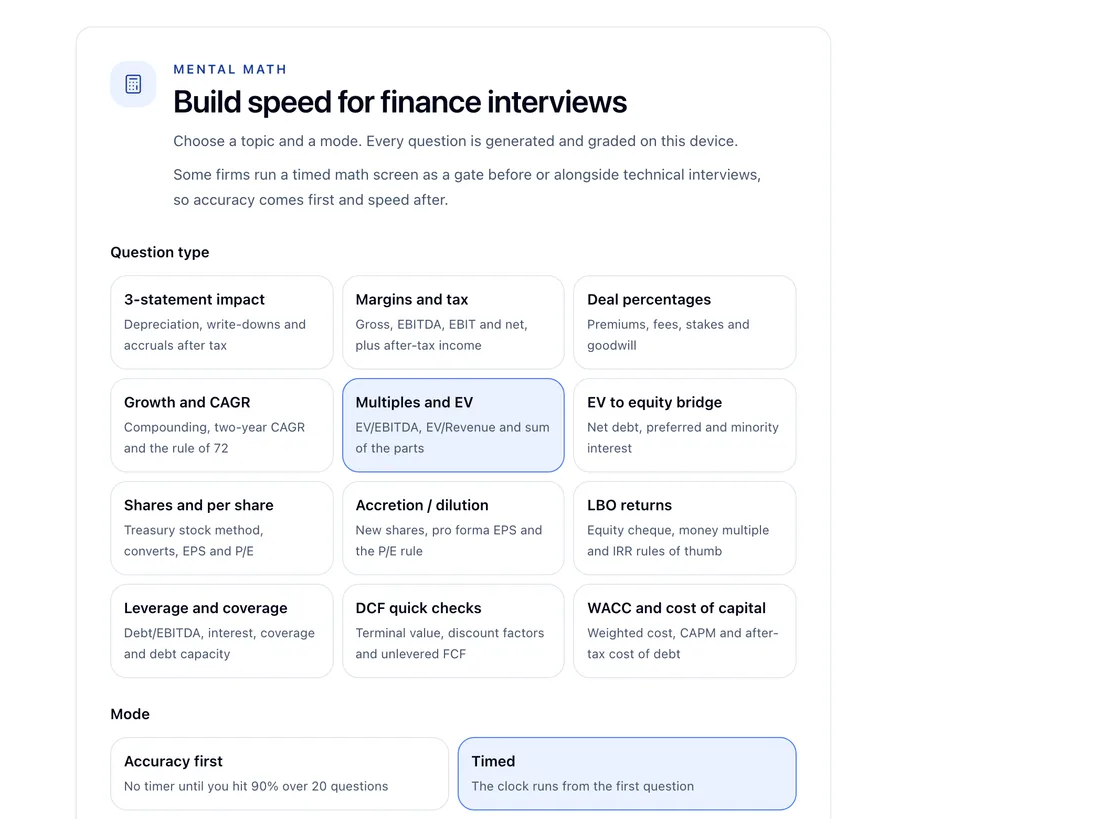
Much of that pricing conversation runs on fast multiples arithmetic, the kind bankers do in their heads while a market window is open.
Quick Math
- EBITDA is $50 million and comparable companies trade at 8x. What enterprise value does that imply, in millions?
EV = EBITDA × multiple. The multiple gives enterprise value, not equity value.
- Enterprise value is $400 million and the company carries $120 million of net debt. What is the equity value, in millions?
Equity value = EV − net debt. Going down from EV to equity, flip the signs.
- Equity value is $280 million and 40 million shares are outstanding. What is the implied price per share?
Price = equity value ÷ shares outstanding.
How is ECM organized into subgroups?
ECM divides into three to four subgroups, each owning a slice of the equity-raising process. Equity Origination pitches companies on raising capital and runs IPOs and follow-ons. Syndicate coordinates with the other banks on a deal to distribute risk, build the order book, and set pricing. Equity-Linked handles convertibles, and some banks add a Private Placements desk that sells equity to a small group of investors.
This structure matters because the subgroups feel like different jobs. Origination is closest to a coverage banker, building pitch materials and managing the client relationship. Syndicate is the most markets-driven, talking to other banks and investors all day to allocate shares and gauge demand. Equity-Linked is the most technical. CFI adds that most large banks run ECM as a joint venture between the ECM and coverage divisions, with the two sides typically splitting fees 50/50, so a deal usually involves both an ECM analyst and a sector coverage analyst.
Valuation · try it first
A high-growth issuer wants to raise 400 million dollars but refuses to sell equity while its share price is depressed. Which ECM subgroup leads, and what do they sell?
How does ECM differ from M&A and the rest of investment banking?
ECM differs from M&A advisory in three ways: it works only on equity deals, the analytical work is lighter, and the hours and exits are different. A coverage or M&A group builds detailed merger models, DCFs, and LBOs and advises on whole transactions. ECM focuses exclusively on equity issuance across every industry, so the work is more qualitative, more markets-oriented, and modeling-lite by comparison.
The trade-off is lifestyle versus optionality. M&I cites a typical ECM day of roughly 7 AM to 7 PM, with all-nighters and weekend work rare, far better than the traditional banking grind. Analyst pay is similar to other groups, though the senior ceiling is lower because fees get "split more ways." The cost shows up at exit: private equity is very difficult to reach from ECM because PE firms want M&A and LBO modeling reps, and headhunters resist capital-markets candidates. Common ECM exits are sector coverage transfers, investor relations, and hedge-fund IR. The debt-side equivalent, debt capital markets (DCM), faces a similar exit constraint for the same reason.
Valuation · try it first
A CFO needs 500 million dollars for expansion. How does the bank decide whether the mandate belongs to ECM or DCM?
Frequently Asked Questions
What is the difference between ECM and DCM?
ECM raises equity (ownership) through IPOs, follow-ons, and convertibles, while DCM raises debt through bond issuance. Both are capital-markets product groups that originate like coverage teams and execute against live markets. The key split: ECM clients sell a stake, DCM clients borrow and repay with interest. See our debt capital markets (DCM) guide for the debt side.
Is ECM a good group for getting into private equity?
No. M&I is direct on this: "if you're laser-focused on the private equity career path, this is not the group for you." PE firms recruit on M&A and LBO modeling experience, which ECM analysts get little of. Stronger ECM exits are sector coverage groups, corporate investor relations, and hedge-fund IR or fundraising roles.
What are the hours like in ECM?
Better than traditional banking. M&I describes a typical day of about 7 AM to 7 PM, with all-nighters and weekends rare, and notes that "if you're done with your work, you can just go home." The equity-linked or convertible desk is the exception, working longer because of the heavier quantitative valuation work.
What is a follow-on offering?
A follow-on offering is when an already-public company issues new equity to raise additional capital. CFI notes follow-ons are "faster and easier to execute" than IPOs because investors already know the issuer, which is also why fees are lower. M&I says follow-ons are the steady business that keeps ECM teams busy between IPOs.
What should I prepare for an ECM interview?
Standard accounting, valuation, DCF, and enterprise-value versus equity-value questions still apply, so review enterprise value vs equity value. The ECM-specific layer is markets interest: M&I says "you need to show more of an interest in the markets," so be ready to discuss recent IPOs and equity-issuance trends. For convertible roles, know calls, puts, and option valuation.
What is a convertible bond?
A convertible bond is a hybrid security that starts as interest-bearing debt but converts into equity if the issuer's share price rises above a set conversion price. ECM's equity-linked desk handles them because they sit between debt and equity, and analysts value the bond component and the embedded equity option separately, then draft a term sheet with the conversion price, maturity, and coupon.
Sources
- Mergers & Inquisitions: Equity Capital Markets (ECM) (checked June 2026)
- Corporate Finance Institute: Equity Capital Markets (ECM) Career Profile (checked June 2026)
- Mergers & Inquisitions: Debt Capital Markets (DCM) (checked June 2026)
- J.P. Morgan: Equity Capital Markets (checked June 2026)
Mental Math
Practise this under time pressure
Speed is the part reading cannot teach. Run a timed set and see where the seconds actually go.
Free, no card. 5 AI-graded reps a day for 3 days from your first rep.