Coverage vs Product Group in Investment Banking
Coverage group vs product group in investment banking: day-to-day work, deal exposure, modeling reps, and the pros and cons for skills and exits.
On this page
A coverage group covers one industry across every deal type, while a product group runs one deal type across every industry. That is the core of coverage vs product group in investment banking. Mergers and Inquisitions frames it as industry bankers focusing on the industry, what companies are doing, and building operating models, while product bankers get to know specific transactional models like merger or LBO models really well. As a default, coverage owns the client relationship and product owns the execution, though real deals blur the line. This guide breaks down the day-to-day differences, the deal exposure each gives you, and the trade-offs for your skill set and exits.
TL;DR
- Coverage groups cover one sector across all deal types; product groups run one deal type across all sectors.
- Coverage bankers build industry knowledge and operating models; product bankers master transaction models like LBO and merger models.
- Get Office Hours says coverage analysts often own the model and do more of the commercial work.
- For exits, M&A and leveraged finance feed private equity and hedge funds hardest; ECM and DCM place less often.
- Mergers and Inquisitions stresses the difference is exaggerated and matters less than bank reputation and genuine interest.
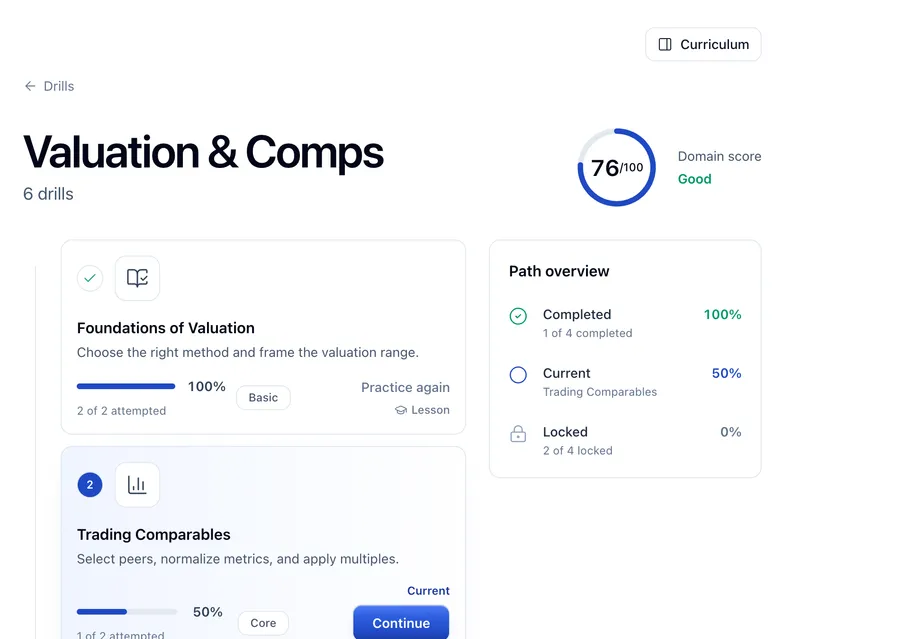
- Four try-first cards below let you rehearse the desk-matching and valuation calls interviewers probe, plus a free valuation drill set.
What is the difference between coverage and product groups?
The difference is the axis of specialization: coverage groups specialize by industry, product groups specialize by deal type. A coverage banker in healthcare advises pharma and biotech clients on every kind of transaction, from M&A to debt and equity raises. A product banker in M&A advises on mergers and acquisitions for clients in every sector.
Get Office Hours captures it well: product groups offer breadth in industry exposure but specialization in deal type, while coverage groups offer exposure to deals across all product categories but only within your specific industry. The two families sit side by side inside the corporate finance division and collaborate on most live deals. The key thing to internalize for interviews is that neither is strictly better; they build different muscles. For the full map of every group, see our types of investment banking groups explained guide.
M&A · try it first
A software company hires your bank to sell itself, and both the TMT coverage team and the M&A product team are staffed. Who owns the client relationship, who owns process mechanics, and what would you actually build on each side?
What does the day-to-day work look like in each?
Day to day, coverage analysts spend more time on industry research and operating models, while product analysts spend more time inside transaction-specific models. Mergers and Inquisitions describes industry bankers as building operating models, meaning three-statement models, and knowing what different companies in the sector are doing. Product bankers get to know merger models or LBO models really well but won't learn industries as deeply.
Get Office Hours adds that coverage analysts tend to own the model and do more of the commercial work, while the division of labor in product groups varies by bank and deal. In practice, on a joint deal the coverage team handles the pitch, comps, and the buyer or target list, and the product team brings execution depth. Mergers and Inquisitions notes the work often splits based on availability rather than rigid roles, so a strong coverage analyst may build the model on one deal and hand it to an M&A analyst on the next. The table below summarizes the split.
| Dimension | Coverage group | Product group |
|---|---|---|
| Specialization | One industry, all deal types | One deal type, all industries |
| Core skill | Industry knowledge, operating models | Transaction models (LBO, merger) |
| Client role | Owns the relationship and origination | Executes the transaction |
| Typical model | Three-statement operating model | Deal-specific model |
Valuation · try it first
Coverage pulled the comps and built the operating model: peers trade at 8.0x to 10.0x EBITDA and your client's EBITDA is 150 million dollars. What enterprise value range goes on the football field, and which side of the split produced each input?
What deal exposure does each give you?
Coverage gives you variety of deal type within one sector; product gives you variety of sector within one deal type. Get Office Hours notes M&A analysts work on both sell-side and buy-side deals across all of the bank's industry groups, while ECM and DCM analysts run equity and debt raises respectively across every industry. A coverage analyst instead sees M&A, debt, and equity deals, but all inside, say, healthcare.
That difference shapes what you learn. A coverage analyst in TMT will understand how technology companies are valued, financed, and consolidated, and will follow the sector's moves closely. The same sector-depth logic applies across desks: see our FIG, healthcare, and real estate group guides for how three other coverage seats differ. An M&A product analyst will see dozens of merger processes a year but rarely go deep on any one industry. Leveraged finance gives the most repetition on debt and LBO structures, which is why it pairs naturally with private equity recruiting. Our walk me through an LBO guide covers the model that leveraged finance and M&A analysts run most.
M&A · try it first
Three mandates land the same morning: an IPO for a payments company, a leveraged loan backing a sponsor buyout, and a sell-side for a mid-cap industrial. Which product desk owns each, and where does coverage plug in on every one?
The comps work above is the coverage desk's first deliverable on any mandate, so the multiples reps belong here:
Practice inside this guide
Valuation multiples practice
Question 1 of 1
Two companies have similar revenue but trade at different EV/EBITDA multiples. What explains the gap?
How do the exits compare?
Exits track the modeling reps each group gives you. Get Office Hours maps it directly: leveraged finance and sponsors feed private equity, structured credit, and hedge funds; M&A feeds private equity, corporate development, and in-house M&A; and coverage groups feed hedge funds, private equity, growth equity, and strategy roles. The shared driver across the strongest exits is heavy LBO and merger modeling.
ECM and DCM are the weakest feeders into buy-side investing because their skill sets overlap less with what private equity and hedge funds do. Mergers and Inquisitions cautions that exit data is anecdotal at best and that a top coverage group like GS TMT can place into private equity at rates comparable to elite product groups. Get Office Hours adds a coverage warning: consumer and retail, TMT, industrials, and healthcare keep your options open, while real estate, FIG, and oil and gas risk pigeonholing you into that single sector. The honest takeaway is that group label matters less than bank reputation and genuine interest. To pressure-test your reasoning, run through our why investment banking answer guide, since interviewers probe group preference there.
Behavioral · try it first
You hold two analyst offers, one in ECM and one in leveraged finance, and your goal is a private equity seat in two to three years. Which do you take, and how do you defend the choice without trashing ECM?
Which should you pick: coverage or product?
Pick the side whose daily work you would actually enjoy, then let exits and bank prestige break the tie. If you like becoming a sector expert, owning the client relationship, and building operating models, lean coverage. If you like running the same deal type repeatedly and going deep on transaction mechanics, lean product, especially M&A or leveraged finance.
Mergers and Inquisitions is direct that the distinction is exaggerated and that at the analyst and associate levels there isn't a big difference in hours, with the one exception being some ECM groups that work lighter weeks, closer to 12-hour days rather than the longer banking norm. The practical move for a generalist who wants maximum optionality is M&A or leveraged finance, both of which build transferable modeling skills and feed the widest set of exits. If you have a real interest in a specific sector, a strong coverage group at a top bank is just as good. Either way, you need to articulate the choice clearly, which is what our investment banking technical interview questions prep helps you defend under follow-up.
Frequently Asked Questions
Is coverage or product better for private equity?
Product groups, specifically M&A and leveraged finance, are the strongest feeders into private equity because of the heavy LBO and merger modeling. Get Office Hours lists leveraged finance and sponsors as routes into private equity, structured credit, and hedge funds. That said, Mergers and Inquisitions notes a top coverage group like GS TMT places into private equity at comparable rates.
Do coverage bankers do modeling?
Yes. Coverage analysts build operating models, the three-statement models for companies in their sector, and Get Office Hours says they often own the model and do more of the commercial work on a deal. They model less of the deal-specific structures, like detailed LBO models, that dedicated product groups run.
Which has better hours, coverage or product?
There is little difference at the junior level. Mergers and Inquisitions states that at the analyst and associate levels there isn't a big difference in hours, with the only exception being some ECM groups working lighter, closer to 12-hour days than the longer banking norm. M&A inside product can be especially intense due to unpredictable deal staffing.
Can you switch from coverage to product or vice versa?
Yes, internal transfers happen, and the skills overlap more than the labels suggest. Mergers and Inquisitions calls the day-to-day distinction exaggerated, so a coverage analyst who has built operating models and seen M&A processes can move into an M&A product group, and product analysts move into coverage to own client relationships.
What is a financial sponsors group, coverage or product?
The financial sponsors group (FSG) is a coverage group, but its clients are private equity firms rather than an industry sector. It advises sponsors on deal structuring and financing across their portfolio. Because sponsors drive leveraged buyouts, FSG sits close to leveraged finance and gives strong private equity exposure.
Does the coverage vs product choice really matter?
Less than candidates assume. Mergers and Inquisitions says it doesn't matter nearly as much as you think, and that bank reputation and your genuine interest in the work outweigh the group label. The strongest signal for exits is heavy modeling experience, which M&A and leveraged finance provide regardless of the coverage-versus-product framing.
Sources
- Mergers & Inquisitions: Industry Groups vs. Product Groups (checked June 2026)
- Get Office Hours: The Ultimate Guide to IBD Groups (checked June 2026)
- Wall Street Prep: Product Groups vs. Industry Groups (checked June 2026)
- Street of Walls: Investment Banking Overview (checked June 2026)
Valuation practice
Practise valuation with a real grade
Take one valuation question, write the answer you would give out loud, and get a real score on it before an interviewer does.
Free, no card. 5 AI-graded reps a day for 3 days from your first rep.