Strategic Rationale in M&A: Meaning and Examples
Strategic rationale in M&A explained with the why this buyer, why this target, why now test, build-vs-buy logic, examples, risks, and interview guidance.
On this page
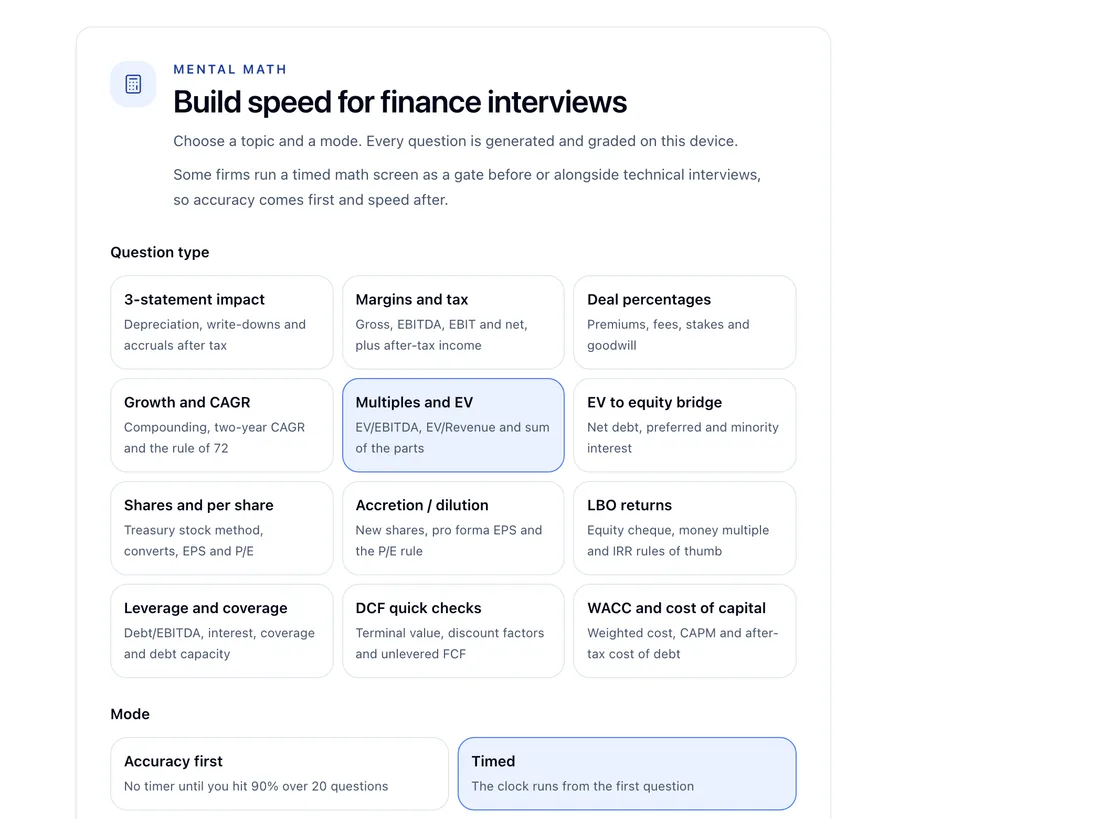
3 timed accretion and dilution questions
Start the timed setAbout 2 minutes. Free account, no card.
Round out your prep
Strategic rationale in M&A is the specific business reason a buyer believes acquiring a target will create more value than remaining separate. A credible rationale answers three questions: why this buyer, why this target, and why now? Growth or synergies alone are not enough. The rationale must explain the mechanism, the alternative to doing the deal, and the execution risk.
TL;DR
- Strategic rationale explains why a particular buyer should acquire a particular target now.
- Common rationales include market entry, capability acquisition, consolidation, vertical integration, and revenue or cost synergies.
- Build vs buy is the key alternative: acquisition should beat internal development, partnership, or doing nothing.
- A board-quality rationale links the strategic goal to measurable value drivers and named risks.
- A deal can be accretive but strategically weak, or strategically logical but value-destructive if the buyer overpays.
- Five try-first reps and one free accretion drill sit inside this guide; type an attempt in each card before the model structure unlocks.
What does strategic rationale mean in M&A?
Strategic rationale is the deal thesis before the transaction model. It connects a buyer's objective to a target's assets and explains how ownership changes the combined company's future cash flows or competitive position.
A weak rationale says, "The acquisition creates growth." A stronger rationale says, "The buyer can distribute the target's fraud-detection product through its existing merchant network, accelerating market entry faster than an internal build." The second version identifies the buyer advantage, target capability, value mechanism, and build-vs-buy logic.
Bankers establish this thesis before sizing synergies, testing accretion or dilution, and recommending a cash, stock, or debt consideration mix.
M&A · try it first
A CEO pitches: 'We should acquire Company X because the deal is immediately accretive.' Rewrite that as a strategic rationale.
What are the main strategic rationales for acquisitions?
Most rationales fit into a small set of categories, although a real deal may combine several.
| Rationale | Value mechanism | Key diligence question |
|---|---|---|
| Market entry | Acquire customers, licenses, or local distribution | Is ownership faster or less risky than entering alone? |
| Capability acquisition | Add technology, talent, data, or intellectual property | Can the capability survive integration? |
| Product expansion | Sell a new product to existing customers | Is there proven customer overlap and sales capacity? |
| Consolidation | Add scale and remove duplicate costs | Will competition rules or customer churn limit value? |
| Vertical integration | Control a supplier or distribution step | Does control outweigh lost flexibility? |
| Portfolio repositioning | Shift toward a faster-growing or more attractive segment | Is the target large enough to change the portfolio? |
| Capital deployment | Invest excess cash at an attractive risk-adjusted return | Does the acquisition beat buybacks, debt paydown, or internal investment? |
The label matters less than the mechanism. "Market entry" becomes useful only when you can name what the target owns that makes entry faster or more defensible.
How do you test why this buyer, target, and timing?
Use a three-part test:
- Why this buyer? Identify an advantage the buyer brings, such as distribution, operating expertise, lower procurement costs, or a complementary product suite.
- Why this target? Name the scarce asset: customers, technology, licenses, geography, talent, brand, or production capacity.
- Why now? Explain the catalyst: a technology shift, industry consolidation, a changing regulatory environment, a target funding need, or a buyer strategy pivot.
If the rationale could describe any buyer or any target, it is too generic. The test should also identify who else could own the asset and whether another buyer could realize more value.
M&A · try it first
Apply the three-part test to a pitch: a payments processor wants a fraud-detection software company because 'fraud is a growing market.' Which parts does it fail?
How does build vs buy affect the rationale?
An acquisition is only one way to reach a strategic goal. The buyer could build the capability internally, sign a commercial partnership, license technology, form a joint venture, or do nothing. A sound deal thesis explains why ownership is the best option.
| Option | Best when | Main drawback |
|---|---|---|
| Build | Capability is close to the buyer's core and time is available | Slow execution and uncertain product-market fit |
| Buy | Speed, scarce assets, or control are critical | Premium, integration risk, and upfront commitment |
| Partner | Flexibility matters and incentives can be aligned | Less control and potential value leakage |
| Do nothing | Expected value does not clear the risk and cost | Strategic opportunity may pass to a competitor |
Buying is more defensible when the target owns something difficult to replicate and time matters. Building is more defensible when the buyer already has the talent, customer access, and patience to develop the capability at lower risk.
M&A · try it first
The buyer can build the fraud capability in-house in three years for 80 million dollars, or buy the target today for 400 million. When is buying still right?
How does strategic rationale create value?
The rationale must ultimately translate into cash flow. A simplified value test is:
Incremental benefits may include cost savings, revenue gains, tax benefits, faster growth, or lower business risk. The premium and integration costs are real offsets. Execution probability also matters: a forecast revenue synergy should not be valued like a contracted cost saving.
This is why a compelling story cannot justify any price. Bankers use precedent transactions, public-company comparisons, and intrinsic valuation to test whether the buyer is transferring too much of the expected value to the seller.
M&A · try it first
A deal's synergy NPV is 500 million dollars, the premium demanded is 450 million, and integration costs are modeled at 80 million. Is the rationale economically sound, and what is the strongest objection?
What are real examples of strategic rationale?
Microsoft's 2016 announcement to acquire LinkedIn framed the rationale around combining LinkedIn's professional network with Microsoft's cloud and productivity products. The stated mechanism was not simply scale. Microsoft specifically connected LinkedIn to Office 365 and Dynamics, creating a thesis around professional identity, enterprise software, and distribution.
ExxonMobil's 2023 agreement to acquire Pioneer Natural Resources framed the transaction around combining complementary acreage in the Permian Basin, scale, operational capabilities, and a larger contiguous resource position. That is a consolidation and capability rationale tied to a specific asset base.
These announcements describe management's expected rationale at signing, not guaranteed realized value. A banker or investor would still test the purchase price, integration plan, regulatory conditions, and whether the claimed benefits actually accrue to shareholders.
What does a board-ready deal thesis include?
A board or investment committee needs more than a list of benefits. A concise decision memo should include:
- the strategic objective and why it matters now;
- the target asset that solves the objective;
- the build, partner, and do-nothing alternatives;
- quantified value drivers with owners and timing;
- the maximum price supported by standalone and synergy value;
- integration dependencies, regulatory risk, and downside cases;
- clear reasons to walk away.
The best rationale is falsifiable. If customer overlap, retention, or cost removal is essential, diligence should identify what evidence would disprove the thesis.
How should you explain strategic rationale in an interview?
Use a compact structure: objective, mechanism, economics, risk. For example: "The buyer may want the target to enter healthcare payments faster. The target brings provider relationships and regulated workflows, while the buyer contributes distribution. The value comes from cross-selling and selected duplicate-cost removal. The biggest risks are customer retention and integration of the regulated product."
For a real transaction, separate management's claim from your analysis. Say what the companies announced, then assess whether the mechanism is credible and whether the price leaves enough value for the buyer.
If the interviewer is asking about your career motivation rather than a company's deal logic, use the separate Why M&A interview answer framework.
M&A · try it first
Deliver the interview answer: 'Walk me through why a strategic buyer can outbid a financial sponsor for the same asset.' Keep it to the mechanism.
Practice inside this guide
Accretion and dilution practice
Question 1 of 1
When is an all-stock acquisition accretive to the buyer's EPS, in one sentence?
Frequently Asked Questions
Are synergies the same as strategic rationale?
No. Strategic rationale is the business reason for the transaction. Synergies are incremental financial benefits that may result from combining the companies.
What is the most credible strategic rationale?
The most credible rationale is specific to the buyer and target, supported by diligence, and tied to measurable cash-flow drivers. It also explains why acquisition is better than building or partnering.
Can an accretive deal have a weak rationale?
Yes. Near-term earnings accretion can result from financing assumptions or accounting effects. It does not prove that the buyer improved long-term intrinsic value.
Can a good strategic deal destroy value?
Yes. Overpayment, integration failure, customer losses, or unrealized synergies can destroy shareholder value even when the original strategic objective was logical.
Why can a strategic buyer pay more than a financial sponsor?
A strategic buyer may have buyer-specific revenue or cost synergies that a sponsor cannot realize. Those benefits can support a higher price, although paying away all expected synergies would leave little value for the buyer.
Sources
- CorpDev: Strategic Rationale for M&A (checked July 2026)
- Microsoft: Microsoft to Acquire LinkedIn (checked July 2026)
- ExxonMobil: Merger with Pioneer Natural Resources (checked July 2026)
- Wall Street Prep: Merger Model (checked July 2026)
Merger math practice
Practise merger math with a real grade
Take one merger math question, write the answer you would give out loud, and get a real score on it before an interviewer does.
Free, no card. 5 AI-graded reps a day for 3 days from your first rep.