LBO Sources and Uses: Table, Example, How to Build
LBO sources and uses explained with a worked example table: the formula, every line item, the purchase-price bridge, rollover treatment, and an interactive builder.
On this page
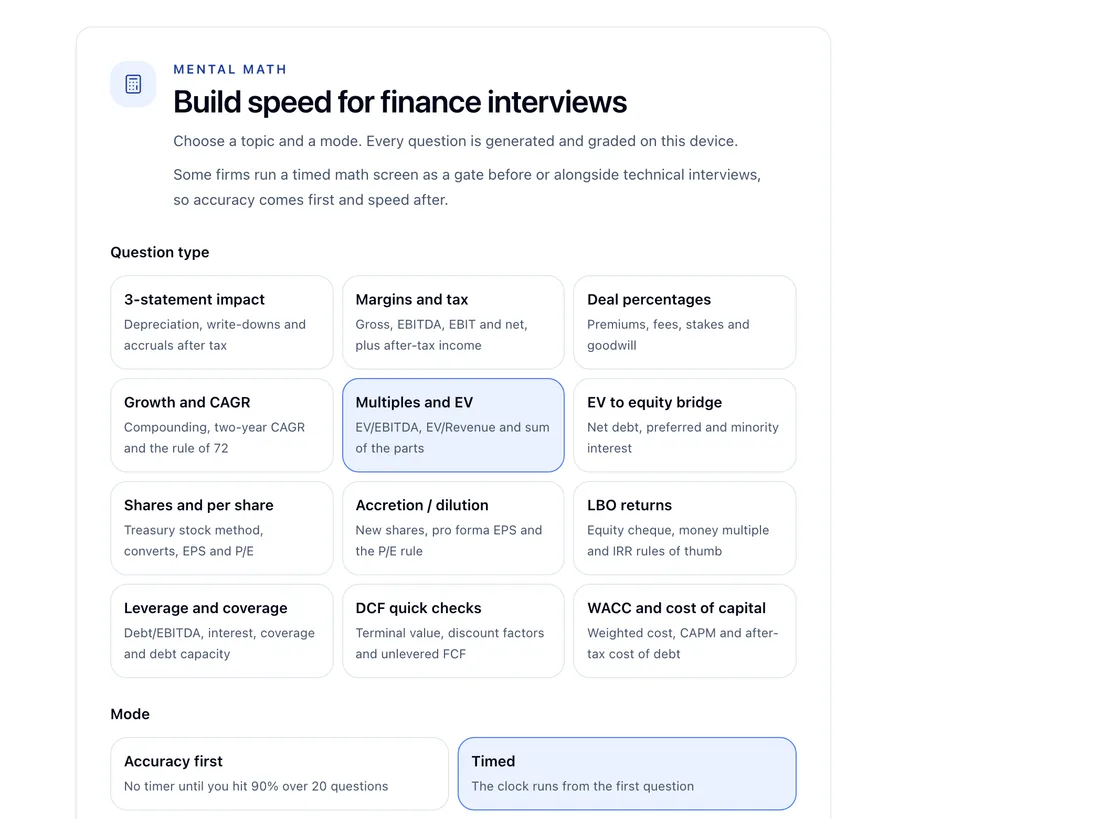
3 timed LBO return questions
Start the timed setAbout 2 minutes. Free account, no card.
Round out your prep
An LBO sources and uses table shows what the acquisition must pay for and where the money comes from, and this guide includes a complete worked example table below. Uses include the equity purchase price, debt refinancing, fees, and cash funded at close. Sources include new debt, rollover equity, co-investor equity, seller financing, and sponsor equity. The table must balance exactly, so sponsor equity is usually the plug after every other source is sized.
TL;DR
- Total sources must equal total uses.
- Start with equity purchase price, then add refinanced debt, fees, and minimum cash.
- Size debt and rollover next. Sponsor equity fills the remaining gap.
- Enterprise value is not always the purchase-price line. Bridge from enterprise value to equity purchase price using debt, cash, and other adjustments.
- Rollover can appear as both a use and a source or as a net reduction to cash paid. Either presentation works if the economics and ownership are consistent.
What is an LBO sources and uses table?
Sources and uses is the closing balance sheet for a transaction. The uses side answers, "What must be funded?" The sources side answers, "Who provides that funding?" It is the first schedule in an LBO model because the debt schedule, ownership split, and sponsor returns all depend on the opening financing mix.
| Uses | Sources |
|---|---|
| Equity purchase price | Revolver and term loans |
| Existing debt refinanced | Junior debt or seller note |
| Transaction fees | Management rollover |
| Financing fees | Co-investor equity |
| Minimum cash funded | Sponsor equity plug |
How do interviewers test sources and uses?
Interviewers rarely just ask you to define sources and uses. They hand you a purchase price, a leverage multiple, and a rollover assumption, then ask you to build the table live, plug sponsor equity, and defend why the plug moved when a fee or debt tranche changed. The test is speed and structure, not memorization: can you list every use, size every source, and reconcile the two sides in under two minutes.
That is exactly the format of the paper LBO practice questions, which walks through building a sources and uses table from a cold set of assumptions with no calculator. Work through it before an interview to convert this page's definitions into the reflex an interviewer actually grades. For more timed reps across the full LBO flow, the LBO practice set has the follow-on questions this page cannot fit. For how the table feeds the full model, see LBO model explained.
What is the sources and uses formula?
The governing equation is:
Sponsor equity is normally calculated last:
If the table does not balance, the model has either omitted a funding source, double-counted a use, or mixed enterprise value with equity value.
How do you bridge enterprise value to purchase price?
Enterprise value measures the value of the operating business to all capital providers. Sellers receive equity value. A simplified bridge is:
Then debt repayment appears as a separate use. For example, suppose enterprise value is 300 million dollars, existing debt is 40 million dollars, and cash delivered to the buyer is 10 million dollars. Equity purchase price is 270 million dollars. The uses side then includes 270 million dollars paid to shareholders plus 40 million dollars to refinance debt.
In practice, the bridge can also include preferred stock, non-controlling interests, unfunded pensions, lease liabilities, and agreed debt-like items. Do not automatically subtract all target cash. The purchase agreement may let the seller keep excess cash while requiring the buyer to fund a minimum cash balance as a separate use. Review enterprise value vs equity value before building the table if this bridge is unclear.
What belongs on the uses side?
Build uses before sources because the required funding should not depend on how the buyer chooses to finance it.
- Equity purchase price: cash or value delivered to selling shareholders.
- Existing debt refinanced: target borrowings repaid or refinanced at close.
- Transaction fees: advisory, legal, accounting, and diligence costs.
- Financing fees: upfront fees and original issue discount on new debt.
- Minimum cash: cash placed on the target balance sheet for operations.
Fees should be assumptions or sourced amounts, not memorized universal percentages. They vary with transaction size, complexity, financing markets, and which costs are capitalized.
What belongs on the sources side?
Sources are all contributions that reduce the sponsor's required check.
- Senior debt: revolver, term loan, or other secured borrowing.
- Junior capital: second-lien debt, mezzanine debt, or preferred equity.
- Seller note: deferred consideration owed to the seller.
- Rollover equity: value reinvested by management or existing owners.
- Co-investor equity: third-party equity invested alongside the sponsor.
- Sponsor equity: the balancing contribution from the private equity fund.
Target cash used to fund the deal can also be a source if the transaction structure and debt documents permit it. Label it clearly so it is not also netted against purchase price.
Sources and uses table: a worked LBO example
Here is a complete labeled example. Assume a 250 million dollar equity purchase price, 20 million dollars of target debt to refinance, 10 million dollars of combined transaction and financing fees, and 5 million dollars of minimum cash. Total uses equal 285 million dollars. New debt contributes 175 million dollars and management rolls 15 million dollars. Sponsor equity is the 95 million dollar plug.
| Uses | Amount | Sources | Amount |
|---|---|---|---|
| Equity purchase price | 250.0M | Term loan B | 140.0M |
| Refinance existing debt | 20.0M | Senior unsecured notes | 35.0M |
| M&A advisory and transaction fees | 7.0M | Management rollover equity | 15.0M |
| Financing fees (OID and upfront) | 3.0M | Sponsor equity (plug) | 95.0M |
| Minimum cash to balance sheet | 5.0M | ||
| Total uses | 285.0M | Total sources | 285.0M |
Amounts are in millions of dollars. Every line is a real category you would see on a deal sources and uses page: the uses side lists what must be funded at close, and the sources side lists who supplies the money. If you want to build one interactively, the LBO sources and uses builder recalculates the sponsor equity plug as you change the debt tranches, rollover, and fee assumptions.
Sources and uses
Both columns tie to the same total, dollar for dollar
Build it yourself
LBO sources and uses
Enter amounts in millions. Sponsor equity fills any remaining funding gap.
Uses
Sources
The sponsor's 95 million dollar check becomes the opening equity investment used to calculate returns in an LBO model. Increasing debt reduces that check but increases interest expense, refinancing risk, and the chance that downside performance impairs equity value.
How should rollover equity be presented?
There are two common presentations:
- Show the full equity purchase price as a use and rollover equity as a source.
- Reduce the cash purchase price by the rollover amount and show only the net cash paid.
The first presentation is often clearer because it preserves the full transaction value and shows who funded the equity. The second is more compact. They should produce the same sponsor check and ownership if applied consistently.
Avoid circular formulas when rollover is defined as a percentage of post-close equity. Calculate total equity required first, solve the rollover and sponsor shares from that equity pool, and then verify the percentages tie to the cap table.
How can you practice the balancing logic?
Start with a blank sheet and write total uses before you size any source. Add the known debt and rollover. Then calculate sponsor equity as the difference. On a second pass, change one use and explain which source must absorb the change. This forces you to understand the plug instead of memorizing a finished table.
Quick Math
- A sponsor buys a company for $500 million of enterprise value and funds it with $300 million of debt. What is the equity cheque, in millions?
Equity cheque = purchase EV − debt raised.
- The deal carries $300 million of debt at a 7% rate. What is annual interest expense, in millions?
Interest = debt × rate. Do that one first.
- The $200 million equity cheque returns $500 million at exit. What is the money multiple?
Money multiple = exit equity ÷ entry equity.
How is strategic M&A different?
The uses side is similar, but the sources side may include buyer cash, new debt, and stock issued to the seller rather than sponsor equity. The funding choice affects EPS, leverage, and ownership dilution, which is why cash vs stock acquisition consideration connects directly to sources and uses.
Sources and uses is the financing plan. The M&A flow of funds is the closing-day settlement schedule that turns the plan into specific payments to sellers, lenders, escrow agents, optionholders, and advisers.
Frequently Asked Questions
Why must sources and uses balance?
Every amount spent at close must be funded. If uses exceed sources, the buyer lacks financing. If sources exceed uses, capital is unallocated or a line has been double-counted.
Is purchase price enterprise value or equity value?
The cash paid to shareholders is equity purchase price. If the model begins with enterprise value, bridge to equity value and show debt refinancing separately so debt is not counted twice.
Is sponsor equity always the plug?
Usually in an interview model, yes. In a live deal, the financing package and sponsor check can be negotiated together, but the final table still needs a clearly identified balancing source.
Where do seller notes and co-investors go?
Both are sources. A seller note is deferred seller financing. Co-investor equity is outside equity contributed alongside the sponsor. Each reduces sponsor equity dollar for dollar.
Does sources and uses appear in a paper LBO?
Yes, usually in compressed form. A paper LBO may show only purchase price, debt, and sponsor equity, but it uses the same balancing logic.
Sources
- Wall Street Prep: Sources and Uses of Funds (checked September 2026)
- Wall Street Prep: Paper LBO (checked September 2026)
LBO practice
Build sources and uses without the worked example
Close the article and build the entry table from scratch here. Reading a completed table is the easy version.
Free, no card. 5 AI-graded reps a day for 3 days from your first rep.