Paper LBO Practice: Worked Example and Three Reps
Solve a paper LBO from entry price to debt paydown, exit equity, MOIC and IRR. Check a worked example, then practise three local calculations.
On this page
A paper LBO is a simplified leveraged buyout calculation: work out the sponsor's initial equity investment, estimate the equity returned at exit, then calculate the multiple and annualised return. Keep enterprise value, debt and equity separate. A correct exit enterprise value is not yet the sponsor's proceeds.
Wall Street Prep presents paper LBOs as short, often timed interview exercises. Follow the actual invitation for the time limit and calculator rules. The same mechanics show up inside a full private equity case study interview, where the model is only one part of the investment decision. The worked example below is an IB Offer teaching example; its simplified assumptions are not a description of every real transaction. Wall Street Prep paper LBO tutorial.
TL;DR
- Entry enterprise value equals EBITDA multiplied by the entry multiple.
- Solve sponsor equity from the complete sources and uses.
- Use cash available after operating costs, interest, tax and investment to calculate debt repayment.
- Bridge exit enterprise value to equity before calculating returns.
- With one investment and one exit payment, annual return equals MOIC raised to one divided by the holding period, minus one.
Private equity
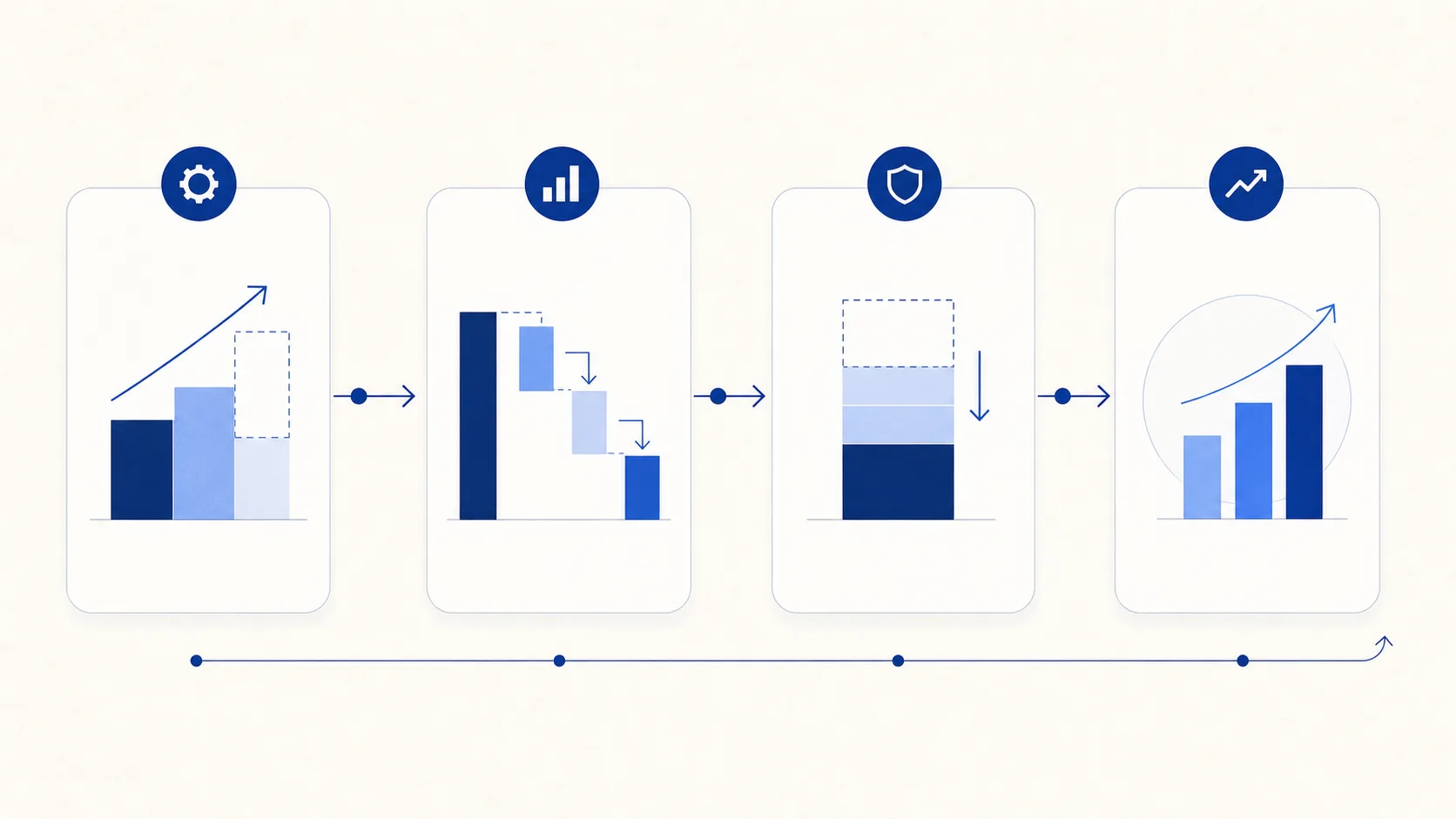
Separate value creation from leverage
Operations
Growth + margin
Balance sheet
Debt paydown
Entry
Price discipline
Exit
Multiple + timing
Underwrite the downside before giving credit for the upside.
What are the five steps to solve a paper LBO?
Write these five outputs on your paper before calculating. They make it easier to locate a mistake.
| Step | Output | Check |
|---|---|---|
| Entry | Enterprise value | Use the stated EBITDA period |
| Funding | Sponsor equity | Sources equal uses |
| Holding period | Exit EBITDA and remaining debt | Do not treat all EBITDA as repayment cash |
| Exit | Sponsor equity proceeds | Subtract remaining debt once |
| Returns | MOIC and IRR | Use the actual holding period and cash-flow timing |
For the verbal explanation, use the LBO walkthrough. Here, focus on the arithmetic that supports it.
How do you set up sources and uses?
Worked example: Buy a debt-free, cash-free business with entry EBITDA of 100 million at 5.0x EBITDA. Fund the purchase with 300 million of new debt. Assume no transaction fees, financing fees, rollover or additional cash requirement. Those exclusions make this a deliberately simple teaching case.
Entry enterprise value is 500 million. Because of our cash-free, debt-free assumption, the purchase use is also 500 million. The new debt funds 300 million and sponsor equity funds the remaining 200 million.
Keep that 200 million visible. It is the denominator of the return calculation. If the prompt adds fees of 10 million with unchanged debt funding, sponsor equity becomes 210 million. Do not leave fees out just because the first example excluded them.
The sources and uses guide covers a fuller transaction bridge. Wall Street Prep also explains how the funding sources balance transaction uses. Sources and uses reference.
How do you project cash flow and pay down debt?
Assume EBITDA grows by 5% each year for five years. The unrounded exit EBITDA is:
For a mental estimate, round it to 130 million and state that choice. Next, assume the prompt gives cumulative cash available for debt repayment of 100 million, after interest, taxes, capital expenditure and working-capital investment. All of that cash repays debt. There are no interim distributions or new borrowings.
Exit debt is therefore 200 million: 300 million at entry less 100 million repaid. Do not also add that same 100 million as cash at exit. It has already been used.
If the prompt instead asks you to derive repayment cash, build it from its stated assumptions. EBITDA alone is not enough. For example, growing revenue may require more working capital, leaving less cash to repay debt. The three-statement guide explains that connection.
How do you calculate exit equity, IRR and MOIC?
Exit at the unchanged 5.0x multiple. Using rounded EBITDA of 130 million gives enterprise value of 650 million. Subtract debt of 200 million to get equity proceeds of 450 million. Assume there is no additional cash, minority interest or other equity-bridge adjustment in this example.
With no interim cash flows, a five-year holding period gives:
Using the unrounded EBITDA instead produces exit equity of about 438.14 million, MOIC of 2.19x and IRR of about 16.98%. The difference comes from rounding, not another source of value. A defensible spoken estimate is roughly 17% to 18%, with the rounding explained.
Quick Math
- A sponsor buys a company for $500 million of enterprise value and funds it with $300 million of debt. What is the equity cheque, in millions?
Equity cheque = purchase EV − debt raised.
- The deal carries $300 million of debt at a 7% rate. What is annual interest expense, in millions?
Interest = debt × rate. Do that one first.
- The $200 million equity cheque returns $500 million at exit. What is the money multiple?
Money multiple = exit equity ÷ entry equity.
The pack provides three local checks of related LBO arithmetic. It is not three complete buyout models. For a full practice run, cover the worked solution and calculate each of the five outputs yourself.
What are the mental math shortcuts to memorise?
The table below is calculated from the same single-entry, single-exit formula over exactly five years. These are benchmarks, not required investor returns.
| Five-year MOIC | Annualised return, rounded |
|---|---|
| 1.5x | 8.4% |
| 2.0x | 14.9% |
| 2.5x | 20.1% |
| 3.0x | 24.6% |
| 3.5x | 28.5% |
The Rule of 72 is a rough doubling shortcut: divide 72 by an annual percentage return to estimate years to double. It is not an exact IRR calculation. A five-year 2.0x result corresponds to about 14.9%, while the shortcut gives 14.4%.
If there are interim dividends or additional equity contributions, MOIC alone cannot determine IRR. Cash-flow dates matter. Use the IRR versus MOIC guide for that distinction.
How do you test whether the result makes sense?
Remove one return driver at a time. In the rounded example, entry equity is 200 million and exit equity is 450 million. The increase consists of 150 million from EBITDA growth at the same multiple and 100 million from debt repayment. There is no multiple expansion.
Now reduce the exit multiple to 4.0x. Exit enterprise value becomes 520 million, equity proceeds become 320 million, and MOIC falls to 1.60x. Five-year IRR is about 9.9%. This shows why “the business grew” does not establish a strong equity return by itself.
Do not declare the investment attractive solely because the base-case arithmetic works. State the operating, financing and valuation assumptions that would need evidence in a real investment assessment.
Frequently Asked Questions
How long should a paper LBO take?
Practise under a chosen limit, then tighten it as your process improves. Wall Street Prep describes short interview exercises, but your actual instructions govern. Do not sacrifice a clear debt-to-equity bridge just to finish a guessed time limit.
Is a calculator always banned?
Follow the interviewer or assessment instructions. Hand calculation is useful preparation, but there is no need to invent a universal rule for every employer.
What is the difference from a full LBO model?
This example takes repayment cash as an input and omits many transaction details. A fuller model derives cash flow, interest, debt movements and returns from linked schedules. The simplified example teaches the relationship between those outputs.
What mistake does this worked example help catch?
Quoting the 650 million exit enterprise value as sponsor proceeds. The debt still outstanding belongs in the bridge: 650 less 200 equals 450 million of equity proceeds under our assumptions.
Sources
- Wall Street Prep: paper LBO tutorial (checked 5 September 2026).
- Wall Street Prep: sources and uses of funds (checked 5 September 2026).
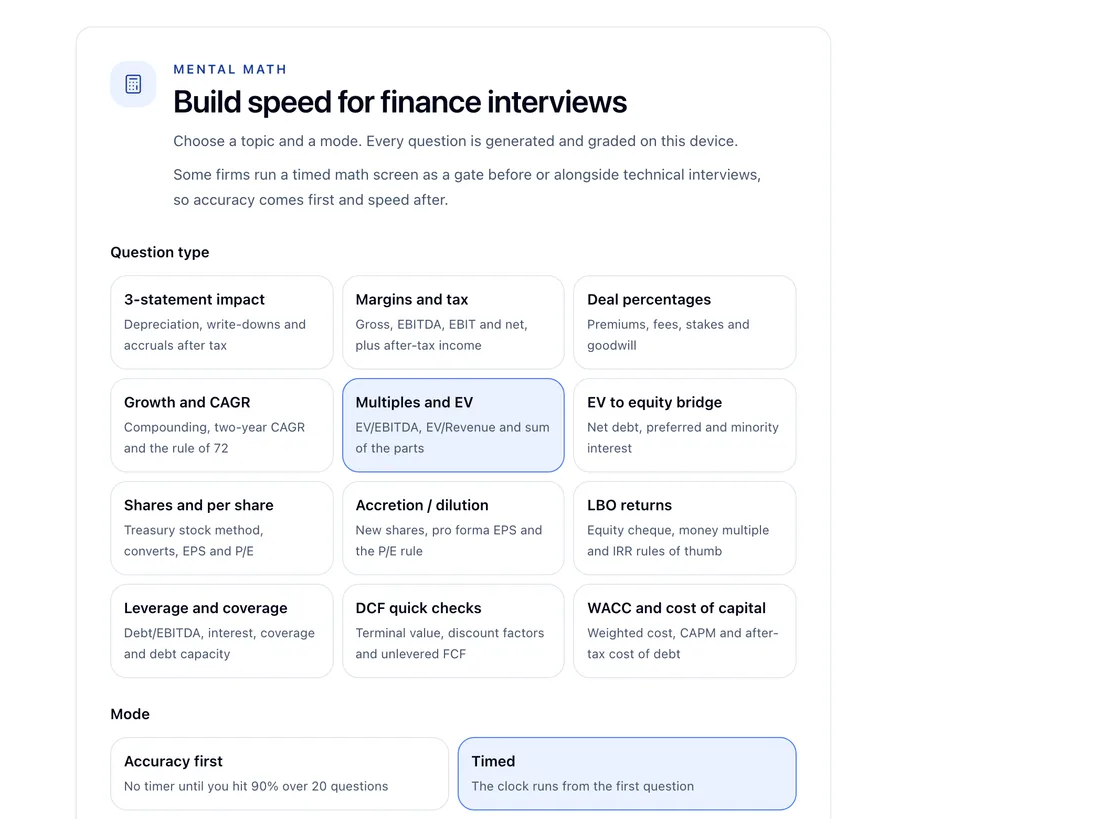
Mental Math
Practise this under time pressure
Speed is the part reading cannot teach. Run a timed set and see where the seconds actually go.
Free, no card. 5 AI-graded reps a day for 3 days from your first rep.