Synergies in M&A: Revenue vs Cost Explained
Learn the types of M&A synergies, revenue and cost examples, run-rate calculations, phase-in, realization costs, and dis-synergy risks.
On this page
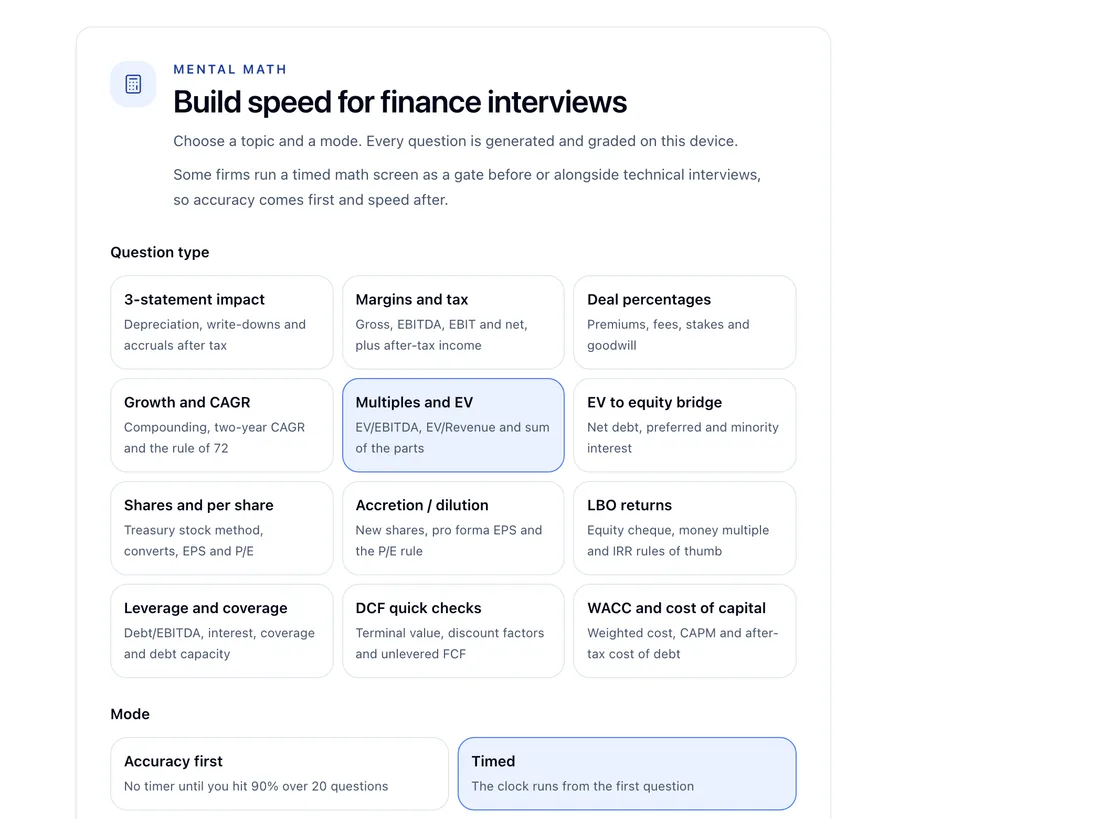
3 timed accretion and dilution questions
Start the timed setAbout 2 minutes. Free account, no card.
Round out your prep
Synergies in M&A are the incremental benefits created by combining two companies. Cost synergies reduce expenses through actions such as eliminating duplicate roles or consolidating vendors. Revenue synergies increase sales through cross-selling, distribution, or complementary products. Cost synergies usually receive more credit in a merger model because management controls the actions more directly. This page is the taxonomy hub: the types of synergies, the revenue-versus-cost distinction, and the modeling posture. For the dedicated worked example, the cost synergies calculation guide walks the full chain from run-rate estimate to after-tax cash impact.
TL;DR
- Cost synergies reduce COGS or operating expenses. Common sources include headcount, procurement, facilities, and technology.
- Revenue synergies increase sales through cross-selling, new channels, broader distribution, or better product coverage.
- Financial synergies are a third category and can include lower financing costs, greater debt capacity, or tax benefits.
- Model synergies with a realistic phase-in, taxes, one-time implementation costs, and downside cases.
- A synergy estimate creates value only when its present value exceeds the cost and risk required to realize it.
What are synergies in M&A?
Synergies are benefits available to the combined company that the buyer and target could not achieve separately. A simple valuation identity is:
| Synergy type | What changes | Example | Modeling treatment |
|---|---|---|---|
| Cost | Expenses fall | Remove duplicate systems | Phase in the pre-tax saving |
| Revenue | Sales rise | Cross-sell into a new channel | Apply a contribution margin |
| Financial | Funding or taxes improve | Lower borrowing cost | Avoid double counting financing assumptions |
| Dis-synergy | Value is lost | Customer churn during integration | Model separately as a downside |
Corporate Finance Institute groups synergies into revenue, cost, and financial categories. In practice, bankers focus first on the operational drivers behind each estimate. A number is not credible merely because it appears in a management case.
Synergies can help a buyer justify paying more than the target's unaffected standalone value. They do not make the premium free. If the buyer pays away all expected synergy value, its shareholders retain little protection against integration delays or underperformance. This is why synergy assumptions matter in both deal rationale and accretion dilution analysis.
How do interviewers test synergies in an M&A interview?
Synergy questions in an interview rarely stop at definitions. You're usually given a target's cost base or an acquirer's EPS and asked to run the number through, showing whether a deal is accretive once phase-in and realization costs are stripped out. Interviewers weight cost synergies more heavily than revenue synergies specifically because they want to see you distinguish a controllable action from an optimistic assumption.
The accretion/dilution practice questions build that exact reflex: given a synergy estimate and a consideration mix, calculate pro forma EPS and state whether the deal is accretive or dilutive. Work through it after this page so the revenue-versus-cost distinction becomes an answer you can run under time pressure, not just a definition. The M&A practice set has further reps on the same math.
What are cost synergies?
Cost synergies are reductions in the combined company's expenses relative to the buyer and target operating independently. Wall Street Prep describes them as savings across COGS and operating expenses after consolidation.
The main cost synergy buckets are:
| Cost bucket | Typical action | Key diligence question |
|---|---|---|
| Headcount | Remove overlapping corporate or support roles | Which roles are truly duplicative, and what severance is required? |
| Procurement | Renegotiate supplier contracts using combined volume | When do contracts reset, and will suppliers pass through savings? |
| Facilities | Consolidate offices, plants, or warehouses | Are leases cancellable, and is capacity genuinely redundant? |
| Technology | Retire duplicate software and infrastructure | What migration cost and operational risk come with consolidation? |
Cost synergies are often called hard synergies because management can identify the action, owner, timing, and expense line. They are still not automatic. Severance, lease termination costs, systems migration, and customer disruption can delay or offset the savings.
For a deeper calculation walkthrough, see cost synergies in M&A.
What are revenue synergies?
Revenue synergies are incremental sales generated by the combined company. Common sources include selling the target's products through the buyer's distribution network, bundling complementary products, entering a new geography, and improving customer coverage.
Revenue synergies require two separate assumptions:
- How much incremental revenue will the combination generate?
- What contribution margin will that revenue produce?
For example, 20 million dollars of incremental revenue at a 30 percent contribution margin creates 6 million dollars of incremental pre-tax operating profit, not 20 million dollars of profit. The model must also consider sales investment, customer churn, channel conflict, and competitive responses.
Revenue synergies are usually called soft synergies because customers must change their behavior for the forecast to work. Management can launch a cross-sell program, but it cannot force customers to buy.
M&A · try it first
A buyer claims 50 million dollars of revenue synergies from cross-selling the target's product into its channel, at a 25 percent contribution margin and a 25 percent tax rate. What actually reaches pro forma net income at maturity?
What are financial synergies?
Financial synergies are benefits created through the combined balance sheet or tax position rather than direct operating improvements. They can include:
- Lower borrowing costs if the combined company has stronger or more stable cash flows
- Greater debt capacity from a larger earnings base
- Tax benefits, subject to legal restrictions and deal structure
- More efficient use of excess cash
Financial synergies deserve separate treatment because they can overlap with financing assumptions elsewhere in the model. A banker should not count a lower cost of debt in the financing schedule and then add the same benefit again as a standalone synergy.
Why are cost synergies more reliable than revenue synergies?
Cost synergies generally receive more credit because management directly controls most of the required actions. It can eliminate a duplicate role, close a facility, or select one enterprise software system. Revenue synergies depend more heavily on customer adoption, sales execution, and market conditions.
That difference changes the modeling posture:
| Factor | Cost synergies | Revenue synergies |
|---|---|---|
| Primary driver | Expense reduction | Incremental sales |
| Management control | Relatively high | Lower |
| Profit conversion | Saving reaches operating profit before tax | Revenue must be multiplied by a margin |
| Typical risk | Execution delays and cost-to-achieve | Adoption, churn, pricing, and competition |
| Diligence evidence | Headcount lists, contracts, leases, systems | Pipeline, customer cohorts, channel capacity |
This does not mean every cost saving is safe or every revenue opportunity is speculative. A signed vendor contract can make procurement savings highly visible. A proven cross-sell pilot can make a revenue case more credible. The quality of evidence matters more than the label.
Synergy realization
Cost synergies capture 70 to 85 percent, revenue only 25 to 35
How do you model synergies in a merger model?
Start with a full run-rate estimate, phase it in over time, apply the correct margin and tax treatment, and include one-time realization costs.
For cost synergies:
For revenue synergies:
Suppose a deal has 40 million dollars of full run-rate cost synergies and realization reaches 25 percent, 60 percent, and 100 percent over three years. The pre-tax savings are 10 million dollars, 24 million dollars, and 40 million dollars. If cost-to-achieve is 50 million dollars spread across the first two years, the early cash impact can be negative even though the mature earnings impact is positive.
The Breaking Into Wall Street merger model guide illustrates why the value of synergies should be compared with the acquisition premium, rather than treated only as an EPS adjustment. Discounting the after-tax cash benefits and subtracting realization costs gives a more complete view.
M&A · try it first
A plan shows 60 million dollars of run-rate cost synergies phasing in at 30 percent in Year 1 and 80 percent in Year 2, with 45 million of cost-to-achieve split 30 and 15. At a 25 percent tax rate, what is net cash impact each year?
How should bankers test a synergy case?
A strong analysis includes at least three cases:
- Base case: management's defensible operating plan
- Downside case: slower phase-in, lower savings, weaker contribution margin, or higher cost-to-achieve
- Upside case: faster execution or broader validated opportunities
Then test the result against the premium paid, accretion or dilution, leverage, and returns. A deal that works only with full and immediate realization is fragile. A deal that remains acceptable with delayed or reduced synergies has a stronger margin of safety.
Watch for dis-synergies as well. Customer churn, lost revenue during integration, employee attrition, duplicated transition teams, and systems disruption can reduce deal value. These effects should not be hidden inside an aggressive net synergy number.
How do you explain synergies in an interview?
Use a four-part answer:
- Define synergies as incremental benefits available to the combined company.
- Separate cost, revenue, and financial synergies.
- Explain why cost synergies are usually more credible.
- Describe phase-in, taxes, realization costs, and downside sensitivity.
If discussing a transaction, connect each estimate to a specific operational action and explain who controls it. That turns a memorized definition into an investment-banking answer. Use the same discipline when you discuss a deal in an interview.
M&A · try it first
An interviewer offers three synergy claims: removing 200 duplicate roles, doubling cross-sell revenue in Year 1, and a lower borrowing rate from combined scale. Classify each and rank them by credibility.
Practice inside this guide
Accretion and dilution practice
Question 1 of 1
When is an all-stock acquisition accretive to the buyer's EPS, in one sentence?
Quick Math
- A target trades at $24.00 a share and the buyer offers $30.00. What premium is the buyer paying?
Premium = (offer − unaffected) ÷ unaffected. The undisturbed price is always the base.
- A bank earns a 1.5% advisory fee on a $240 million deal. What is the fee, in millions?
Anchor on 1% of the deal, then scale: 1% of $240M is $2.4M, half of that is $1.2M.
- A sponsor owns 15% of a company with $80 million of equity value. What is the stake worth, in millions?
15% = 10% + 5%: take a tenth, then add half of it.
Frequently Asked Questions
What is the difference between revenue and cost synergies?
Revenue synergies increase sales through actions such as cross-selling or geographic expansion. Cost synergies reduce expenses through actions such as headcount, procurement, facilities, or technology consolidation.
Do synergies increase enterprise value?
Yes, if they create incremental after-tax cash flow. The present value of that cash flow increases the combined company's enterprise value, but realization costs and integration risk reduce the net benefit.
Why do synergies affect accretion and dilution?
After-tax synergies increase pro forma net income and therefore pro forma EPS. Cost synergies usually convert to profit more directly, while revenue synergies require a margin assumption. See goodwill and purchase accounting for the other major merger-model adjustments.
Are run-rate synergies the same as realized synergies?
No. Run-rate synergies are the annual savings or profit contribution expected once the plan is fully implemented. Realized synergies are the amount actually achieved in a specific period.
Can synergies be negative?
Yes. Dis-synergies such as customer losses, employee attrition, duplicate transition costs, or systems disruption can reduce the value of a combination.
Sources
- Wall Street Prep: Synergies in M&A (checked July 2026)
- Corporate Finance Institute: Types of Synergies (checked July 2026)
- Breaking Into Wall Street: Cost Synergies in Merger Models (checked July 2026)
- DealRoom: Types of M&A Synergies (checked July 2026)
Merger math practice
Practise merger math with a real grade
Take one merger math question, write the answer you would give out loud, and get a real score on it before an interviewer does.
Free, no card. 5 AI-graded reps a day for 3 days from your first rep.