EV to Equity Value Bridge: Components and Example
Enterprise value bridge explained component by component, including debt, cash, preferred stock, minority interest, pensions, and a worked example.
On this page
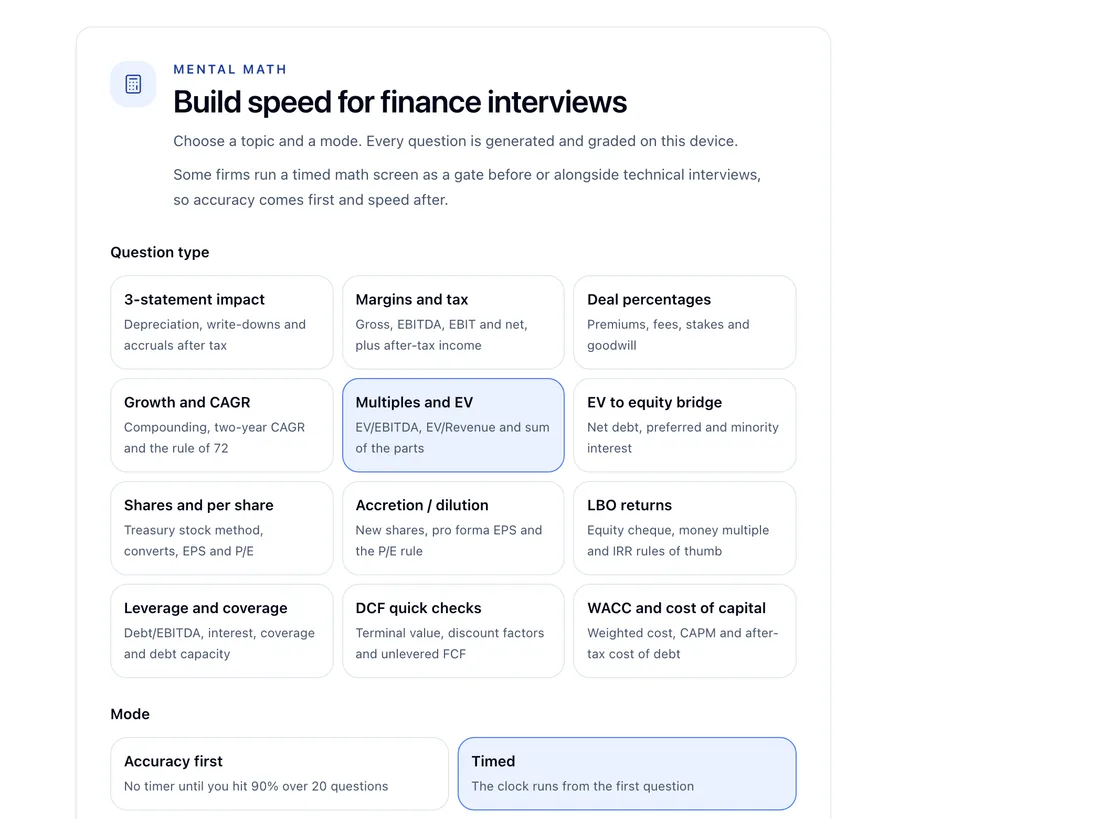
3 timed EV bridge questions
Start the timed setAbout 2 minutes. Free account, no card.
Round out your prep
The enterprise value bridge, component by component, starts with equity value, then adds debt, preferred stock, minority interest, and other debt-like claims while subtracting cash and non-operating assets. It converts the value of common equity into the value of the entire operating business. Wall Street Prep's equity value to enterprise value bridge uses the same core formula: enterprise value equals equity value plus total debt, preferred equity, and minority interest, minus cash and equivalents. This lesson deepens the summary in enterprise value vs equity value by explaining why each item is added or subtracted. For private-deal adjustments, see debt-like items in M&A.
TL;DR
- Add debt because an acquirer assumes or repays it to own the business.
- Subtract cash because excess cash reduces the effective purchase price.
- Add preferred stock because it is a claim ahead of common equity.
- Add minority interest when the company consolidates less-than-100-percent-owned subsidiaries.
- Other adjustments can include pensions, leases, investments, and non-operating assets.
What is the enterprise value bridge?
The enterprise value bridge converts common equity value into total enterprise value. Equity value belongs to common shareholders. Enterprise value belongs to all capital providers and reflects the value of the operating business regardless of capital structure. The standard formula is:
Interviewers test the bridge because it reveals whether you understand valuation consistency. If the numerator is enterprise value, the denominator must be available to all capital providers, such as EBITDA or EBIT. That is why EV/EBITDA works and EV/net income does not. To test the bridge under time pressure, run the enterprise value bridge practice questions.
Why do you add debt?
You add debt because a buyer of the whole company must deal with it, either assuming it or repaying it at close. Debt holders have a claim on enterprise value ahead of equity holders, so equity value alone understates the operating business. If a company has 1,000 million dollars of equity value and 400 million dollars of debt, it is not worth only 1,000 million dollars to an acquirer: the acquirer has to account for both the equity purchase and the debt claim.
EV Bridge · try it first
A company has an equity value of 1,600 million dollars and total debt of 500 million dollars, with no preferred stock, no minority interest, and no cash adjustment. What is its enterprise value, and why does the debt belong in it?
Why do you subtract cash?
You subtract cash because cash reduces the effective cost of acquiring the business. If the buyer acquires a company with 100 million dollars of excess cash, that cash can be used to repay debt, fund operations, or offset the purchase price. In the bridge, cash is treated as a non-operating asset unless it is minimum operating cash needed to run the business. The simplified formula uses total cash and equivalents, but a detailed model may separate operating cash from excess cash.
EV Bridge · try it first
Equity value is 900 million dollars, total debt is 350 million dollars, and cash and equivalents are 200 million dollars. What is enterprise value? Then flex it: if 60 million dollars of that cash is minimum operating cash the business needs, what does enterprise value become?
Why add preferred stock and minority interest?
Preferred stock is added because preferred holders have a claim ahead of common shareholders, similar to a debt-like security. Minority interest is added because accounting consolidation can include 100 percent of a subsidiary's revenue and EBITDA even when the parent owns less than 100 percent. To keep comps consistent, the numerator must include the minority claim if the denominator includes the subsidiary's full operating results. CFI gives this same consistency logic in its minority-interest enterprise value discussion.
| Component | Add or subtract? | Reason |
|---|---|---|
| Debt | Add | Non-common claim assumed by buyer |
| Cash | Subtract | Reduces effective purchase price |
| Preferred stock | Add | Claim ahead of common equity |
| Minority interest | Add | Matches consolidated EBITDA or revenue |
| Investments | Usually subtract | Non-operating asset not in EBITDA |
EV Bridge · try it first
A parent owns 80 percent of a subsidiary and consolidates its full results. Equity value is 2,000 million dollars, debt is 450 million, preferred stock is 100 million, minority interest is valued at 120 million, and cash is 150 million. Compute enterprise value and explain why the minority interest goes in.
What is a worked example?
Equity value to enterprise value
Add non-common claims, subtract cash, land on enterprise value
Suppose a company has a 50 dollar share price and 20 million diluted shares. Equity value is 1,000 million dollars. It has 300 million dollars of debt, 40 million dollars of preferred stock, 60 million dollars of minority interest, and 120 million dollars of cash. Enterprise value is 1,000 plus 300 plus 40 plus 60 minus 120, or 1,280 million dollars.
If EBITDA is 160 million dollars, EV/EBITDA is 8.0x. That multiple is capital-structure neutral because it includes all capital-provider claims in the numerator.
Now change only cash from 120 million dollars to 220 million dollars. Enterprise value falls to 1,180 million dollars, and EV/EBITDA falls to 7.4x. The operating business did not get worse. The bridge changed because extra cash reduces the effective purchase price. This is why candidates should avoid saying enterprise value is simply "market cap plus debt." Cash and other non-operating assets matter.
The same logic applies in reverse when debt rises and cash does not. Enterprise value rises because more non-common claims sit ahead of common shareholders.
EV Bridge · try it first
A company trades at 32 dollars per share with 25 million diluted shares. It carries 280 million dollars of debt, 50 million of preferred stock, no minority interest, and 90 million of cash. Compute equity value, enterprise value, and EV/EBITDA if EBITDA is 130 million dollars.
How do you walk the bridge in reverse?
The bridge runs backward just as cleanly, and in practice it runs backward more often: an unlevered DCF produces enterprise value, and you must walk down to equity value and a per-share price. The rule is to flip every sign. Subtract debt, preferred stock, and minority interest, the non-common claims, and add back cash and non-operating assets, which the buyer receives but the operating business did not earn.
Same company, reverse direction: enterprise value of 1,280 million dollars, minus 300 of debt, minus 40 of preferred stock, minus 60 of minority interest, plus 120 of cash, gives equity value of 1,000 million dollars. Divided by 20 million diluted shares, the implied price is 50 dollars, exactly the price the forward bridge started from. The check that catches errors: the reverse bridge should always land back where you began, and if it does not, a sign flipped somewhere in the middle.
The shorthand version uses net debt: equity value equals enterprise value minus net debt minus preferred minus minority interest, where net debt is debt minus cash. Bundled that way, the same bridge gives 1,280 minus 180 of net debt minus 40 minus 60, still 1,000. This is also the answer to the classic wrinkle "a company raises 100 of debt and holds it as cash": debt rises 100 and cash rises 100, so net debt and enterprise value do not move, because a pure financing event just reshuffles claims instead of changing the operating business.
Practice inside this guide
Enterprise value bridge practice
Question 1 of 1
A company has an enterprise value of 500, debt of 120, and cash of 40. What is its equity value, and what did you assume about other claims?
The set above runs the bridge in both directions, including what happens when a company raises new debt and holds it as cash. For a graded rep, use the valuation practice page; for more bridge reps, run the full enterprise value bridge practice questions set.
Quick Math
- Equity value is $500 million, debt is $200 million, and cash is $50 million. What is enterprise value, in millions?
EV = equity value + debt + preferred + minority interest − cash.
- Enterprise value is $800 million with $150 million of debt, $40 million of preferred, $20 million of minority interest, and $30 million of cash. What is equity value, in millions?
Walking down from EV: subtract every other claimant, add cash back.
- EBITDA is $90 million, peers trade at 9x, and the company carries $160 million of net debt. What is the implied equity value, in millions?
Implied equity = EBITDA × multiple − net debt. Two steps, always.
The quick-math set above runs the bridge with a number pad, including the multiples tie-in, which is the exact sequence an interviewer will chain together.
Frequently Asked Questions
Why do you add debt to enterprise value?
Because an acquirer must assume or repay the debt to own the whole business. Debt is a claim on the operating enterprise, not part of common equity value.
Why do you subtract cash from enterprise value?
Cash reduces the effective purchase price because the buyer receives it at close. In simplified interview answers, subtract cash and equivalents.
When do you add minority interest?
Add minority interest when the company consolidates a subsidiary it does not fully own. The adjustment keeps enterprise value consistent with consolidated EBITDA or revenue.
Do you add operating leases?
Often yes under modern lease accounting, analysts may treat lease liabilities as debt-like. The interview answer should mention leases as a possible debt-like adjustment, not always as a mandatory simple-bridge item.
How does this bridge connect to a DCF?
An unlevered DCF produces enterprise value. To get equity value, subtract net debt and other non-common claims, then divide by diluted shares.
Sources
- Wall Street Prep, "Equity Value to Enterprise Value Bridge": https://www.wallstreetprep.com/knowledge/equity-value-to-enterprise-value-bridge/ (checked July 2026)
- Corporate Finance Institute, "Enterprise Value (EV)": https://corporatefinanceinstitute.com/resources/valuation/what-is-enterprise-value-ev/ (checked July 2026)
- Corporate Finance Institute, "Minority Interest in Enterprise Value": https://corporatefinanceinstitute.com/resources/valuation/minority-interest-in-enterprise-value-calculation/ (checked July 2026)
Enterprise value practice
Practise enterprise value with a real grade
Take one enterprise value question, write the answer you would give out loud, and get a real score on it before an interviewer does.
Free, no card. 5 AI-graded reps a day for 3 days from your first rep.