Diluted Share Count: Options, Warrants, Treasury Method
Diluted share count explained for IB interviews with options, warrants, convertibles, treasury stock method formula, and a full worked example.
On this page
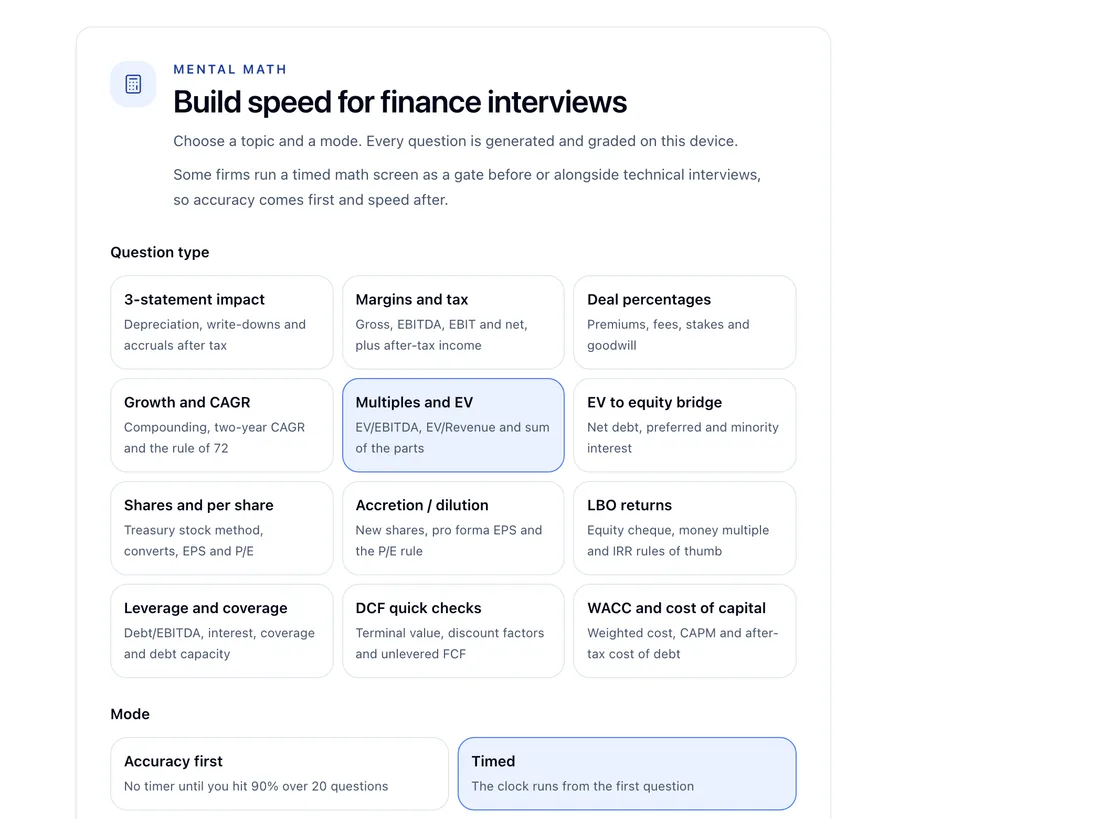
3 timed diluted share questions
Start the timed setAbout 2 minutes. Free account, no card.
Round out your prep
Diluted share count includes common shares plus in-the-money options, warrants, restricted stock units, and potentially convertible securities that could become common shares. The most tested mechanic in investment banking interviews is the treasury stock method. Wall Street Prep defines it as calculating the net new shares from options and warrants by assuming the company uses exercise proceeds to repurchase shares at the current share price. Diluted shares feed equity value, per-share valuation, P/E, and enterprise value bridge calculations. Use basic shares when diluted shares are required, and every per-share output comes out too high.
TL;DR
- Diluted share count starts with basic shares and adds net new shares from dilutive securities.
- Options and warrants are dilutive only when exercise price is below the current share price.
- Treasury stock method assumes exercise proceeds repurchase shares at market price.
- Net new shares equal options minus shares repurchased with exercise proceeds.
- Diluted shares affect equity value, P/E, implied share price, and merger-model stock issuance.
What is diluted share count?
Diluted share count estimates how many common shares would exist if dilutive securities became common shares. Basic shares count only common shares currently outstanding. Diluted shares add instruments that can convert into or create common stock, such as options, warrants, RSUs, and convertibles. In valuation, diluted shares are usually the correct denominator because buyers and public-market investors care about the ownership base after potential dilution. This matters for equity value vs enterprise value, because market capitalization equals share price times fully diluted shares outstanding.
What is the treasury stock method?
The treasury stock method calculates net new shares from options and warrants. It assumes all in-the-money options are exercised, then assumes the company uses the cash proceeds to repurchase shares at the current market price. The formula is:
Options are in the money when the current share price exceeds the exercise price. Out-of-the-money options are ignored because rational holders would not exercise them.
Valuation · try it first
A company has 80 million basic shares and 5 million options at a 25 dollar strike. The stock trades at 40 dollars. How many diluted shares does the treasury stock method give?
What is a worked example?
Suppose a company has 100 million basic shares, 10 million options, an exercise price of 20 dollars, and a current share price of 50 dollars. Exercise proceeds are 10 million times 20 dollars, or 200 million dollars. At 50 dollars per share, the company can repurchase 4 million shares. Net new shares are 10 million minus 4 million, or 6 million. Diluted shares are 106 million.
Treasury stock method
Exercise proceeds buy back shares, so only the net new shares dilute
If the share price were 15 dollars, the options would be out of the money and add zero shares.
Valuation · try it first
The same company reports the stock fell to 18 dollars. Two candidates disagree: one keeps the 6 million net new shares, the other drops them. Who is right and what breaks in their model if they keep them?
How do convertibles differ from options?
Convertible securities are usually handled with the if-converted method, not the treasury stock method. If conversion is dilutive, you assume the security converts into common shares and reverse the interest expense or preferred dividends that would no longer be paid. The interview version is usually conceptual: options and warrants use treasury stock method; convertibles use if-converted method. For a quick technical interview, make that distinction and then solve the option math cleanly.
| Security | Typical method | Key test |
|---|---|---|
| Options | Treasury stock method | Current price above exercise price |
| Warrants | Treasury stock method | Current price above strike price |
| RSUs | Add if vested or dilutive | Often no exercise proceeds |
| Convertible debt | If-converted method | EPS dilution test |
| Convertible preferred | If-converted method | EPS dilution test |
Why does diluted share count matter in deals?
Diluted share count affects offer value, exchange ratio, ownership split, and per-share outputs. If a buyer offers 30 dollars per share, the equity purchase price should use diluted shares, not just basic shares. In a stock deal, the number of new buyer shares issued depends on the purchase price and buyer share price. That new share count flows into merger model pro forma EPS. Dilution also affects employee options and rollover equity in some transactions.
It also affects implied share price in a DCF. If equity value is 1,060 million dollars and diluted shares are 106 million, implied share price is 10 dollars. If a candidate incorrectly uses 100 million basic shares, the implied price becomes 10.60 dollars. The valuation did not improve. The denominator was wrong. That 6 percent overstatement is exactly the kind of small-looking mechanics error that can make a model output unreliable.
In interviews, always ask whether the prompt wants basic or diluted shares if the share count is ambiguous. If no clarification is available, state that valuation work normally uses diluted shares.
Valuation · try it first
A buyer offers 30 dollars per share for a target with 50 million basic shares and 4 million net new option shares. The junior analyst priced the deal at 1,500 million dollars. What is the correct equity purchase price and why does the error cascade?
Practice inside this guide
Enterprise value bridge practice
Question 1 of 1
A company has an enterprise value of 500, debt of 120, and cash of 40. What is its equity value, and what did you assume about other claims?
Quick Math
- A target trades at $24.00 a share and the buyer offers $30.00. What premium is the buyer paying?
Premium = (offer − unaffected) ÷ unaffected. The undisturbed price is always the base.
- A bank earns a 1.5% advisory fee on a $240 million deal. What is the fee, in millions?
Anchor on 1% of the deal, then scale: 1% of $240M is $2.4M, half of that is $1.2M.
- A sponsor owns 15% of a company with $80 million of equity value. What is the stake worth, in millions?
15% = 10% + 5%: take a tenth, then add half of it.
Frequently Asked Questions
What is the difference between basic and diluted shares?
Basic shares count common shares currently outstanding. Diluted shares add the net impact of securities that could become common shares, such as in-the-money options, warrants, RSUs, and convertibles.
When are options dilutive?
Options are dilutive when the current share price is above the exercise price. If the exercise price is higher than the current share price, the options are out of the money and excluded.
Why does treasury stock method repurchase shares?
It assumes the company receives cash from option exercise and uses that cash to buy back shares at the current market price. Only the net new shares are added.
Do RSUs have exercise proceeds?
Usually no. RSUs generally convert into shares when vested, so there may be no exercise price proceeds to offset dilution.
Which share count should be used for market capitalization?
Use fully diluted shares outstanding for valuation work unless the interview prompt tells you otherwise. It gives a more complete view of the equity claim.
Sources
- Wall Street Prep, "Treasury Stock Method": https://www.wallstreetprep.com/knowledge/treasury-stock-method/ (checked July 2026)
- Corporate Finance Institute, "Treasury Stock Method": https://corporatefinanceinstitute.com/resources/valuation/treasury-stock-method/ (checked July 2026)
- Wall Street Prep, "Equity Value to Enterprise Value Bridge": https://www.wallstreetprep.com/knowledge/equity-value-to-enterprise-value-bridge/ (checked July 2026)
Enterprise value practice
Practise enterprise value with a real grade
Take one enterprise value question, write the answer you would give out loud, and get a real score on it before an interviewer does.
Free, no card. 5 AI-graded reps a day for 3 days from your first rep.