How to Build a Merger Model: Pro Forma Combination
How to build a merger model by combining buyer and target financials, purchase accounting, synergies, financing effects, and pro forma EPS math.
On this page
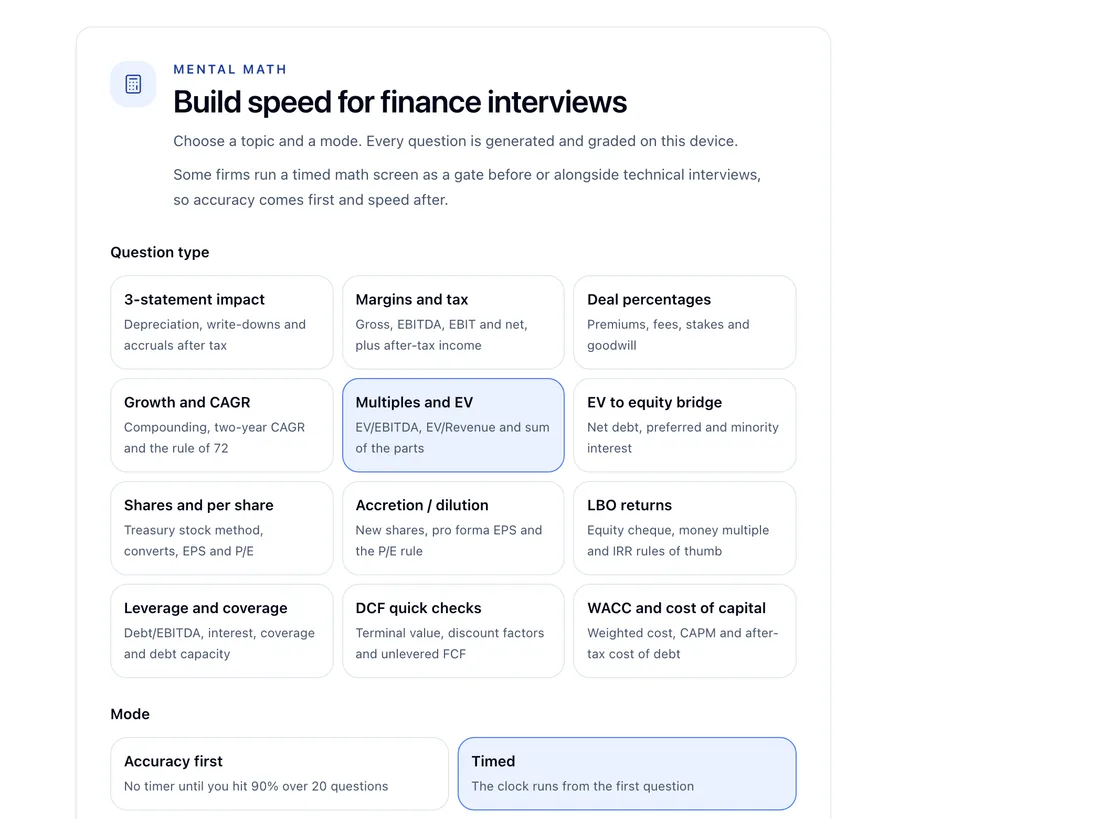
3 timed accretion and dilution questions
Start the timed setAbout 2 minutes. Free account, no card.
Round out your prep
How to build a merger model starts with the pro forma combination: buyer financials plus target financials, adjusted for purchase accounting, financing, synergies, and new share count. The output is usually pro forma EPS, which tells you whether the deal is accretive or dilutive. Wall Street Prep defines a merger model as the analysis used to evaluate the financial impact of an M&A transaction, especially the effect on the acquirer's EPS. The model is not just two income statements pasted together. You must add the target, adjust for new debt interest or stock issuance, include realistic synergies, and reflect goodwill and purchase accounting. This lesson covers the skeleton that the accretion dilution shortcut assumes.
TL;DR
- A merger model combines buyer and target financials, then adjusts for deal financing and purchase accounting.
- Pro forma EPS equals adjusted combined net income divided by pro forma diluted shares.
- Cash and debt create after-tax interest effects; stock increases share count.
- Goodwill is created when purchase price exceeds the fair value of identifiable net assets.
- The model's interview output is usually accretive, dilutive, or breakeven EPS impact.
M&A
The merger model in three layers
Layer 1
Buyer + target
Standalone earnings
Layer 2
Deal effects
Financing + PPA + synergies
Layer 3
Pro forma
Net income ÷ diluted shares

What is a merger model?
A merger model estimates what the acquirer will look like after buying the target. In a public-company acquisition, the central question is often EPS impact: does pro forma EPS go up or down compared with the buyer's standalone EPS? Wall Street Prep's merger-model tutorial frames the model around combining the financial statements of the acquirer and target and measuring accretion or dilution. In interviews, you do not need to build a full Excel model from scratch, but you do need to explain the steps and the logic behind each adjustment.
What are the steps to combine the companies?
Start with the buyer's standalone income statement. Add the target's income statement for the same forecast period. Then layer in transaction adjustments: synergies, incremental D&A from asset write-ups, new interest expense from debt financing, lost interest income from cash used, and new shares from stock consideration. Finally, divide adjusted combined net income by the pro forma diluted share count.
| Step | Adjustment | EPS effect |
|---|---|---|
| Add target net income | Adds earnings | Accretive |
| Add cost synergies | Adds after-tax income | Accretive |
| Add debt interest | Reduces net income after tax | Dilutive |
| Use cash | Reduces interest income after tax | Dilutive |
| Issue shares | Raises denominator | Dilutive |
This is why M&A consideration mix matters. The same target can be accretive with cash and dilutive with stock.
M&A · try it first
Put the adjustments in order: buyer net income is 200 million dollars, target net income is 40 million, after-tax synergies are 10 million, after-tax new debt interest is 12 million, and 15 million new shares are issued on a 90 million base. What is pro forma EPS?
What is the pro forma EPS formula?
The interview version is:
After-tax adjustments include synergies, incremental interest expense, lost interest income, and new amortization or depreciation from purchase accounting where relevant. If pro forma EPS exceeds buyer standalone EPS, the deal is accretive. If it is lower, the deal is dilutive.
What is a worked example?
Suppose the buyer has 100 million dollars of net income and 50 million shares, so standalone EPS is 2.00 dollars. The target has 20 million dollars of net income. The buyer funds the deal with debt that creates 8 million dollars of pre-tax interest expense, and the tax rate is 25 percent. There are no synergies and no stock issued. After-tax interest expense is 6 million dollars. Pro forma net income is 100 plus 20 minus 6, or 114 million dollars. Shares stay at 50 million, so pro forma EPS is 2.28 dollars.
Since 2.28 dollars is above 2.00 dollars, the deal is accretive by 0.28 dollars, or 14 percent.
If the same buyer issued 10 million new shares instead of using debt, combined net income would be 120 million dollars and pro forma shares would be 60 million. EPS would be exactly 2.00 dollars, so the deal would be breakeven before synergies. This is the cleanest way to see why financing mix changes the answer even when the target's standalone earnings are identical. The operating deal did not change. The denominator changed.
M&A · try it first
Same buyer (100 million net income, 50 million shares, 2.00 dollar EPS). Now the deal uses 10 million new shares AND adds 6 million of after-tax synergies. Accretive or dilutive?
How do purchase accounting and goodwill fit?
Purchase accounting adjusts the target's balance sheet to fair value after the acquisition. If the buyer pays more than the fair value of identifiable net assets, the difference becomes goodwill. That logic is covered in goodwill and purchase accounting. In a full merger model, purchase accounting can create incremental D&A or amortization, which reduces pro forma net income. In a shorter interview model, candidates often mention goodwill conceptually and focus the math on financing effects and EPS.
M&A · try it first
The buyer pays 900 million dollars for a target whose identifiable net assets have a fair value of 650 million. What lands on the pro forma balance sheet, and what does it do to EPS later?
Practice inside this guide
Accretion and dilution practice
Question 1 of 1
When is an all-stock acquisition accretive to the buyer's EPS, in one sentence?
Quick Math
- A buyer funds a $480 million all-debt acquisition at 5% pre-tax with a 25% tax rate. What is the annual after-tax interest cost, in millions?
After-tax interest = new debt × rate × (1 − tax rate).
- Combined net income is $150 million and the buyer has 120 million shares after issuing stock for the deal. What is pro forma EPS?
Pro forma EPS = combined net income ÷ combined shares.
- Standalone EPS is $2.00 and pro forma EPS is $2.10. What is the accretion, in percent?
Accretion = (pro forma EPS − standalone EPS) ÷ standalone EPS.
The set above isolates the three calculations the accretion call comes down to: the after-tax cost of new debt, the pro forma EPS, and the accretion percentage itself.
Frequently Asked Questions
What is the purpose of a merger model?
The purpose is to estimate the financial impact of an acquisition on the buyer, most commonly whether pro forma EPS is accretive or dilutive.
Is a merger model the same as an accretion dilution model?
They overlap. Accretion dilution analysis is usually the key output of a merger model, but a full merger model also includes purchase accounting, balance-sheet adjustments, financing schedules, and sometimes detailed forecasts.
Why does stock consideration dilute EPS?
Stock consideration increases the buyer's share count. Even if net income rises from adding the target, EPS can fall if the new shares increase the denominator too much.
Why does debt financing often help accretion?
Debt is often cheaper than equity after tax because interest is tax-deductible. If the target's earnings yield exceeds the after-tax cost of debt, debt financing pushes the deal toward accretion.
Should synergies always be included?
No. Include only realistic, defensible synergies. Cost synergies are easier to model than revenue synergies because they usually have clearer timing and probability.
Sources
- Wall Street Prep, "Merger Model": https://www.wallstreetprep.com/knowledge/merger-model/ (checked July 2026)
- Street of Walls, "Merger Model: Accretion Dilution": https://www.streetofwalls.com/articles/investment-banking/recruiting-interviewing/merger-model-accretion-dilution/ (checked July 2026)
- Breaking Into Wall Street, "EPS Accretion Dilution": https://breakingintowallstreet.com/kb/ma-and-merger-models/eps-accretion-dilution/ (checked July 2026)
Merger math practice
Practise merger math with a real grade
Take one merger math question, write the answer you would give out loud, and get a real score on it before an interviewer does.
Free, no card. 5 AI-graded reps a day for 3 days from your first rep.