Investment Banking Online Assessments: Tests and Prep
Investment banking online assessments explained: the four test families, which banks use which format, and how to prepare in the week before.
On this page
Investment banking online assessments are the timed tests banks send right after you apply, before any human interview. They fall into four families: aptitude tests (numerical, verbal, and logical reasoning), situational judgement tests, personality and cognitive assessments (including game-based formats), and immersive job simulations that blend all three. Preparation reports suggest this stage removes more candidates than any other in early-career recruiting, so the week before your invitation is where the pass is won. This guide maps the families, the firm-by-firm formats, and the prep that actually moves scores.
TL;DR
- Online assessments arrive after application and before any interview; prep guides report they eliminate the majority of applicants at many banks.
- Four families cover almost everything banks send: aptitude tests, situational judgement tests, personality or game-based assessments, and job simulations.
- Deadlines are tight: UBS gives a 168-hour window with no retakes, and most banks allow one attempt per cycle (official, UBS).
- Firm formats differ sharply, so prep for your bank's vendor, not "assessments" generally.
- Numerical reasoning improves fastest with timed reps; the other families reward consistency and judgment more than study.
What do online assessments actually test?
Banks face applicant pools in the hundreds of thousands for a few thousand early-career seats, and assessments are the scalable filter between application and interview. Every format measures some mix of the same four things.
| Family | What it measures | Common formats | Reported users |
|---|---|---|---|
| Aptitude tests | Numerical, verbal, and logical reasoning under time pressure | Data interpretation, sequences, reading comprehension | Barclays, UBS (AON), BNP Paribas psychometrics |
| Situational judgement tests | Decision quality in realistic workplace scenarios | Rank or rate responses to scenarios | Most bulge brackets, inside simulations or standalone |
| Personality and game-based | Cognitive style, behavioral traits, risk and attention profiles | Trait questionnaires, short games | JPMorgan historically used pymetrics (now retired) |
| Job simulations | All of the above in one realistic workflow | Inbox prioritization, video responses, mini-cases | HSBC, Barclays immersive formats |
Two rules apply across the families. First, scoring rewards accuracy under time pressure more than raw reasoning power, so pacing is a skill in itself. Second, consistency matters: personality and judgement items repeat in disguised forms, and contradictory answers flag as gaming.
Which banks use which assessments?
Formats change between cycles and regions, and banks rarely name their vendors publicly. The table below marks what firms publish themselves versus what candidates report; always read your own invitation over any guide, including this one.
| Bank | Published by the firm | Reported by candidates |
|---|---|---|
| JPMorgan | Online application, then a recorded HireVue and/or HackerRank for technology (digital handbook) | Pymetrics games used from roughly 2019 to 2024 are retired; current cycles report video only |
| UBS | Four AON assessments: verbal, numerical, inductive-logical reasoning, and Culture Match, due within 168 hours, no retakes | Pass results stay valid six months across applications |
| BNP Paribas | Online psychometric tests, then video interview and assessment centre (UK) | Strength-based HireVue plus fit-heavy HR screen |
| Barclays | Not published in detail | Immersive job simulation mixing aptitude and judgement items |
| HSBC | Not published in detail | Job simulation format reported, similar blended style |
One freshness note: several older prep guides still list JPMorgan's pymetrics games as the first screen. JPMorgan's own digital handbook now describes only a recorded virtual interview over HireVue and/or HackerRank for technology roles, and candidates in recent cycles report video without games. If your invitation names pymetrics, follow it; if it names HireVue, prep for a recorded interview instead of games.
How do numerical and reasoning tests work?
Numerical reasoning items give you a chart, table, or short data set and ask questions under roughly 30 to 60 seconds each. The math itself is arithmetic, percentages, ratios, and growth rates; the difficulty is the clock. These are original IB Offer exercises, not leaked test items. Work the card, then check the method.
Numerical Reasoning · try it first
A chart shows revenue growing from 80 to 104 in two years. What is the compound annual growth rate, and what would year three's revenue be at the same rate?
Numerical Reasoning · try it first
A fund holds positions worth 240, 360, and 600 million in three sectors. What percentage of the portfolio is the largest position, and what is the ratio of the smallest to largest?
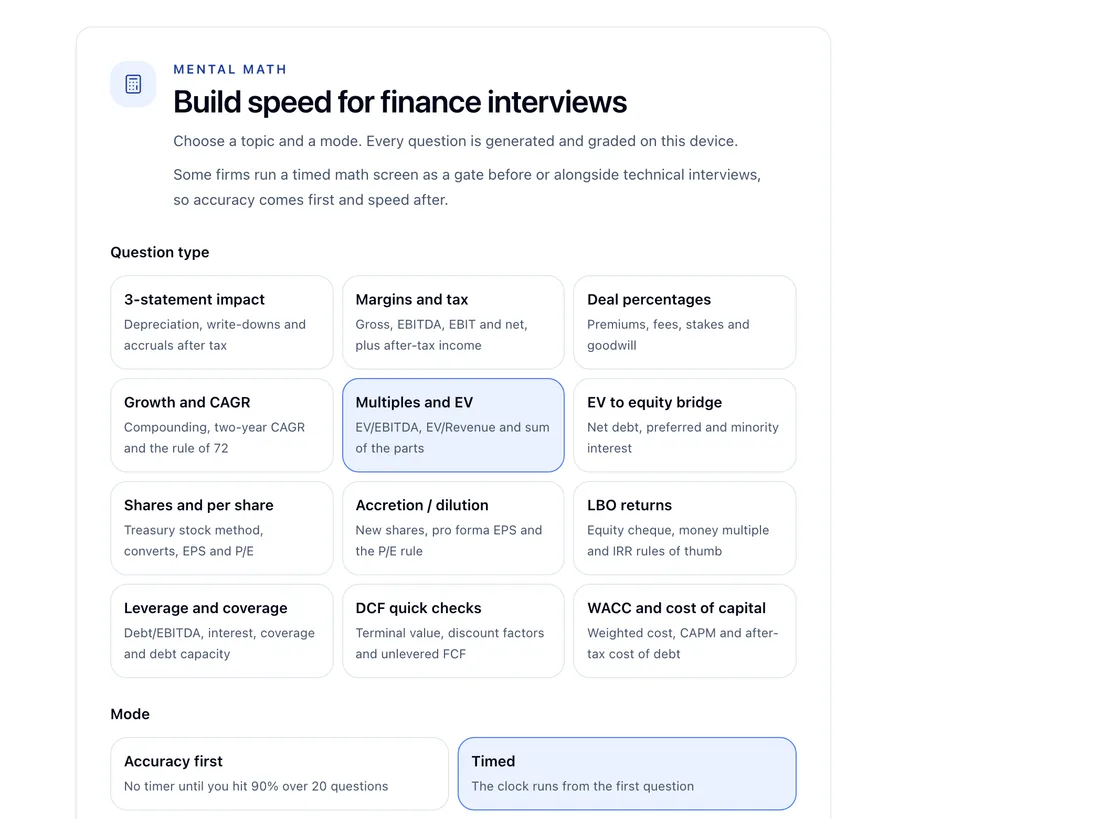
Timed percentage, ratio, and growth drills are exactly what these tests score; the mental math practice test and numerical reasoning guide carry more reps, and the percentages and multiples guide covers the question shapes.
How do situational judgement and personality tests score you?
Situational judgement tests present a workplace scenario (a manager asks you to finish a deck while a client call overruns, a teammate ships an error) and ask you to rank or rate responses. Banks score them against the judgment profile they want: ownership, escalation, client-first sequencing, and honesty over heroics. The losing answers are the passive ones (wait and see) and the reckless ones (hide the problem). The winning answers usually combine immediate client-facing fixes with flagging issues upward honestly.
Judgement · try it first
A VP asks you to fix a model error you found, right before a client meeting in ten minutes, while your analyst peer insists it can wait. What do you do?
Personality and game-based items resist preparation more than any other family. Answer honestly and consistently; the same trait measured five ways flags contradictions, and the tests score fit profiles rather than right answers. For the standalone format, the situational judgement test guide goes deeper into what banks score.
Drill set: judgement reps
One free rep matched to the judgement family above. Finish it and the prompt to keep practicing appears.
Practice inside this guide
Situational judgement practice
Question 1 of 1
You find a material error in a teammate's model shortly before delivery. What do you do first?
How should you prepare in the week before?
Assessment prep is short-cycle: a focused week beats a diffuse month. Run it in order.
- Day one to two: identify the vendor and format from your invitation or recent candidate reports for your bank and region. Prep is only useful if it matches the real test.
- Day two to four: timed numerical reps daily. Ten to fifteen questions against a hard clock builds the pacing skill these tests actually score.
- Day four to five: judgement scenarios. Practice ranking responses and saying the reasoning out loud; if your logic matches client-first and honest-escalation patterns, the ranking follows.
- Day five to six: a full dress rehearsal. Same device, same room, same time of day, phone off, water ready. Do not take the real test on a laptop you have never typed on.
- Day seven: light review only. Use the official practice material where the bank provides it; UBS, for example, points candidates to AON's practice assessments on its careers pages.
Where the assessment sits in the wider process, the recruiting timeline guide maps it, and the assessment centre guide covers the in-person stage that usually follows.
Frequently Asked Questions
What are online assessments in investment banking?
Timed tests banks send after you apply and before interviews. They cover aptitude (numerical, verbal, logical), situational judgement, personality or game-based profiling, and sometimes immersive job simulations that blend all three.
How many applicants fail investment banking assessments?
Banks do not publish pass rates. Prep guides commonly report this stage eliminates the majority of applicants, sometimes cited above half, but treat that figure as reported, not official. It is the largest volume cut in early-career recruiting.
Can you retake an investment banking assessment?
Usually no. UBS states results cannot be retaken and an incomplete set withdraws the application (official). Where a bank allows retakes, windows are typically six to twelve months. Assume one attempt per cycle.
Does JPMorgan still use pymetrics?
Not in recent cycles. JPMorgan's digital handbook describes a recorded HireVue and/or HackerRank for technology, and candidates report video without games since roughly the 2025 to 2026 recruiting cycles. Follow whatever your own invitation names.
How long do you get to complete the tests?
It varies by firm. UBS gives a 168-hour window from the invitation (official); other banks typically give a few days to a week. The link usually expires at the deadline, so clear focused time the day the invite lands.
Are online assessments the same as a HireVue?
No, though some banks run them in sequence or blend them. Assessments are scored tests with right answers or profile fits; HireVue is a recorded interview reviewed by people. JPMorgan's process, for example, treats the recorded interview as its own virtual-assessment step (official).
Sources
- JPMorganChase: Digital Handbook (official, checked September 2026)
- UBS: Early Careers FAQ (official, checked September 2026)
- BNP Paribas UK: Internships (official, checked September 2026)
- Game Assessment Prep: JPMorgan pymetrics status (prep provider, checked September 2026)
- PrepLounge: Online Assessments in Investment Banking (prep provider, checked September 2026)
Mental Math
Practise this under time pressure
Speed is the part reading cannot teach. Run a timed set and see where the seconds actually go.
Free, no card. 5 AI-graded reps a day for 3 days from your first rep.