Asset Management Investment Process Explained
A practical guide to idea generation, research, portfolio construction, monitoring, and sell discipline in fundamental asset management.
On this page
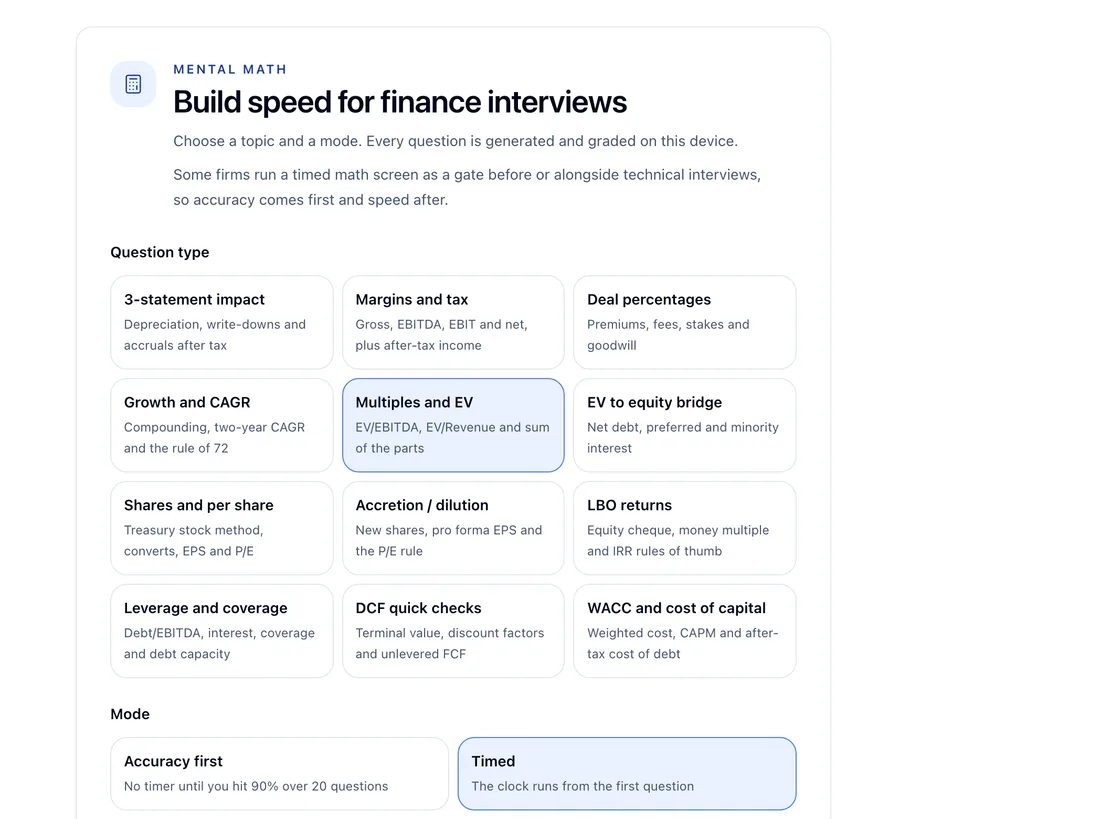
3 timed valuation multiple questions
Start the timed setAbout 2 minutes. Free account, no card.
Round out your prep
An asset management process turns research into repeatable portfolio decisions. It defines what the strategy is allowed to own, how ideas enter the portfolio, how risk affects position size, and what evidence triggers a sale. The process matters because a correct company view can still produce a poor portfolio outcome when the price, size, liquidity, or time horizon is wrong.
TL;DR
- Begin with a clear mandate, benchmark, horizon, and risk budget.
- Research the business and the expectation already embedded in its price.
- Size positions by expected return, downside, confidence, correlation, and liquidity.
- Monitor thesis evidence rather than daily price movement alone.
- Sell when the thesis breaks, value is realized, or a better risk-adjusted use of capital appears.
Asset management
A repeatable investment process
01
Mandate
02
Research
03
Size
04
Monitor
05
Exit
Portfolio construction
One position, three risk lenses
Thesis
Business downside
Portfolio
Correlation
Trading
Liquidity
What is the investment mandate?
The mandate sets the boundaries of the portfolio. It may specify asset class, geography, market capitalization, liquidity, benchmark, concentration, income needs, and environmental or regulatory constraints. A global equity fund and a short-duration credit portfolio cannot use the same idea-generation or risk process.
Before discussing securities in an interview, clarify the objective. Is the strategy trying to outperform a benchmark, preserve capital, generate income, or meet a liability? Over what horizon, and with what tolerance for drawdowns? Those questions prevent a pitch from becoming disconnected from the client or portfolio.
| Process stage | Decision | Evidence required |
|---|---|---|
| Mandate | What can the portfolio own? | Objective and constraints |
| Research | Is price different from value? | Drivers, expectations, valuation |
| Construction | How much should the fund own? | Return, downside, correlation, liquidity |
| Monitoring | Is the thesis progressing? | Operating and market indicators |
| Exit | Is capital better used elsewhere? | Thesis, value, risk, opportunity cost |
How do managers generate and research ideas?
Ideas can come from industry screens, valuation dislocations, structural changes, company events, supply-chain work, or prior research. The source matters less than a consistent research standard. Define the business model, financial drivers, competitive advantage, management incentives, balance-sheet risk, valuation, catalysts, and disconfirming evidence.
Use primary information where possible: regulatory filings, earnings materials, debt documents, and industry data. Reconcile earnings with cash flow through the three financial statements, then build the expectation-focused argument described in the equity research thesis lesson.
How does research become a position size?
Position size is not a confidence score by itself. A manager also considers potential loss, volatility, correlation with existing holdings, liquidity, factor exposure, and the strategy's concentration limits. A compelling small-cap idea may need a smaller position because exiting it during stress could be difficult.
A simple expected-return framework is:
Here, each probability is paired with an upside, base, or downside return. The result is only as useful as the scenarios. Stress the assumptions that matter and compare expected gain with permanent-loss risk. Diversification reduces security-specific risk, but adding many similar exposures does not create genuine diversification.
Worked example: sizing an equity idea
Assume a stock has a 25 percent probability of gaining 40 percent, a 50 percent probability of gaining 12 percent, and a 25 percent probability of losing 30 percent. The probability-weighted return is 8.5 percent:
That result does not automatically justify a large position. If the stock is illiquid and already moves with the portfolio's largest holdings, the manager may start at 1 percent rather than 3 percent. A better entry price, stronger evidence, or lower portfolio correlation could justify adding later. The example separates security attractiveness from portfolio fit.
What should a manager monitor?
Write the thesis and checkpoints before buying. Track the operating indicators that support or challenge it: customer growth, pricing, margins, market share, leverage, regulation, or capital allocation. Compare new facts with the original expectation rather than explaining every result after the fact.
Price movement can contain information, but it is not proof that the thesis is right or wrong. Ask whether the expected return changed because fundamentals changed, the valuation changed, or both. Market context from rates, spreads, and macro can also change the appropriate discount rate or risk budget.
When should an investment be sold?
Common sell reasons are thesis impairment, valuation reaching or exceeding fair value, deteriorating risk-reward, a mandate constraint, or a superior opportunity. Avoid vague rules such as "sell after a 20 percent gain." A gain may reflect improving fundamentals, while a falling price may increase expected return if the thesis remains intact.
The difficult case is a partially broken thesis. Return to the original evidence: which assumption failed, how much does it change value, and would you initiate the same position today? If not, inertia is not a valid reason to hold.
How do you explain an investment process in an interview?
Use a six-step answer: mandate, idea source, fundamental research, valuation, construction, and monitoring or exit. Give one example of how risk changed your position size. This shows that you understand investing as a portfolio discipline, not a collection of isolated stock pitches.
Practice inside this guide
Valuation multiples practice
Question 1 of 1
Two companies have similar revenue but trade at different EV/EBITDA multiples. What explains the gap?
The free rep asks why similar-revenue companies trade at different EV/EBITDA multiples; reveal the authored model structure for a self-check, not an AI grade.
Frequently Asked Questions
Is diversification always better?
No. Diversification can reduce idiosyncratic risk, but excessive positions may dilute the best ideas or hide correlated exposures.
What is active risk?
Active risk is the variability of portfolio returns relative to a benchmark. It reflects security, sector, factor, and other deviations from that benchmark.
What is a good reason to change a position size?
A material change in expected return, downside, confidence, correlation, liquidity, or portfolio constraints can justify resizing.
Sources
- U.S. Securities and Exchange Commission, "Investment Companies": https://www.investor.gov/introduction-investing/investing-basics/glossary/investment-company (accessed July 2026)
- CFA Institute, "Portfolio Management: An Overview": https://www.cfainstitute.org/insights/professional-learning/refresher-readings/2026/portfolio-management-overview (accessed July 2026)
- FINRA, "Asset Allocation and Diversification": https://www.finra.org/investors/investing/investing-basics/asset-allocation-diversification (accessed July 2026)
Valuation practice
Practise valuation with a real grade
Take one valuation question, write the answer you would give out loud, and get a real score on it before an interviewer does.
Free, no card. 5 AI-graded reps a day for 3 days from your first rep.