How to Build an Equity Research Investment Thesis
Build a research thesis from earnings drivers, expectations, valuation, catalysts, and risks rather than a generic company summary.
On this page
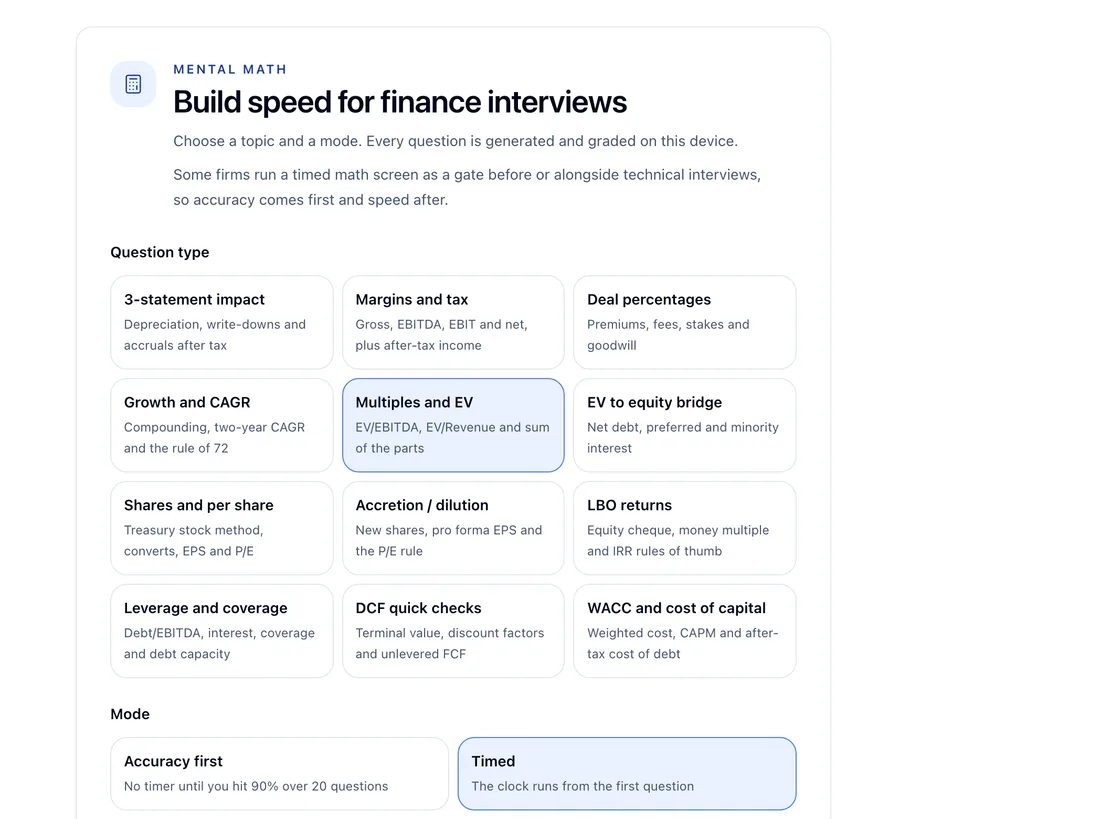
3 timed valuation multiple questions
Start the timed setAbout 2 minutes. Free account, no card.
Round out your prep
An equity research thesis explains why a stock should perform differently from what its current price implies. It is not a description of a good company. The analyst must identify the market expectation embedded in valuation, form a differentiated view of the operating drivers, and state what evidence could prove that view wrong.
TL;DR
- Start with the expectation in the price, not the company story.
- Reduce the model to the 2 or 3 drivers that actually change earnings and value.
- State the variant view, catalyst, valuation, and risk in one connected argument.
- Use scenarios instead of hiding uncertainty in one precise target price.
- Define disconfirming evidence before recommending the stock.
Equity research
A thesis is an expectation gap
Expectations
What is priced in?
Variant view
Where do you differ?
Catalyst
What changes beliefs?
Risk
What proves you wrong?
Research discipline
Evidence must move an estimate
Evidence
New information
Estimate
Driver changes
Decision
Price vs value
What belongs in an investment thesis?
A practical thesis has five linked parts. First, identify consensus expectations. Second, state where your operating view differs. Third, explain the evidence and mechanism. Fourth, identify the catalyst that may close the expectation gap. Fifth, value the resulting cash flows or earnings under explicit scenarios.
| Thesis element | Question to answer | Weak substitute |
|---|---|---|
| Expectations | What does the price appear to assume? | The company is a leader |
| Variant view | Where is your estimate different? | The industry will grow |
| Evidence | Why should your estimate be right? | Management is strong |
| Catalyst | What may change investor beliefs? | The stock is cheap |
| Risk | What would invalidate the thesis? | Macro uncertainty |
The framework forces specificity. A company can have attractive products and still be a poor investment if the valuation already assumes exceptional execution.
How do you find the key earnings drivers?
Read filings and earnings materials to understand how the business earns revenue and converts it into cash. Then connect each material line to an operating driver: units and price, customers and revenue per customer, stores and sales per store, utilization and rate, or assets and fee rate. Trace margins through variable costs, fixed costs, and mix.
Build a simple historical model before making a forecast. Reconcile unusual items, watch working capital, and compare earnings with cash generation using the three-statement framework. The goal is not to model every account. It is to know which assumption changes the conclusion.
What is a variant view?
A variant view is a reasoned difference from the expectation reflected in the stock. Suppose consensus expects revenue growth to slow from 12 percent to 7 percent because a mature product is decelerating. Your research may show that a newer product has better retention and a larger eligible customer base than investors assume. The thesis is not simply "growth will be strong." It is that the mix shift can keep growth near 10 percent, with evidence from disclosed customer data and unit economics.
The variant must be material. A 20 basis point margin difference rarely supports a major recommendation unless the market is highly sensitive to it. Test the conclusion with a DCF and comparable-company analysis, but do not average methods mechanically.
How should you use valuation and scenarios?
Use a base case that represents your most likely assumptions, a downside case that captures the main thesis risk, and an upside case that reflects better execution without fantasy. Each case should change operating drivers, not just the valuation multiple.
Valuation should answer what must happen for the recommendation to work. Reverse a DCF or earnings multiple to estimate the growth and margin path implied by the current price. If your target depends on both perfect execution and multiple expansion, the thesis is fragile.
Worked example: turning a variant view into expected return
Suppose a stock trades at 100. Consensus assumes revenue growth falls to 7 percent. Your channel work supports 10 percent growth because a newer product is retaining customers better than expected.
| Scenario | Probability | Price | Return |
|---|---|---|---|
| Upside: adoption accelerates | 25% | 135 | 35% |
| Base: growth holds near 10% | 50% | 118 | 18% |
| Downside: consensus is right | 25% | 78 | -22% |
The probability-weighted return is 12.25 percent. The thesis is investable only if that return compensates for the 22 percent downside and if the retention evidence can be monitored. This is stronger than presenting 118 as a precise target with no range or failure condition.
What makes a catalyst credible?
A catalyst is an event or accumulation of evidence that can change expectations. Examples include a product launch, pricing change, cost program, regulatory decision, refinancing, or several quarters of improving retention. A scheduled earnings date alone is not a catalyst unless you can explain which data point may surprise investors and why.
State the time horizon. A valid long-term thesis can lose money if the expected evidence arrives later than the investment mandate allows. Monitor leading indicators and define thesis checkpoints.
How do you present the thesis in an interview?
Lead with the recommendation, price-implied expectation, and variant view. Then cover 2 supporting drivers, valuation, catalyst, and the most important risk. The structure in how to make a stock pitch is useful, but research interviews reward explicit evidence and willingness to revise the view.
End with what would change your mind. That signals discipline rather than weak conviction. A strong analyst is paid to update beliefs when facts change.
Practice inside this guide
Valuation multiples practice
Question 1 of 1
Two companies have similar revenue but trade at different EV/EBITDA multiples. What explains the gap?
The free rep asks why similar-revenue companies trade at different EV/EBITDA multiples; reveal the authored model structure for a self-check, not an AI grade.
Frequently Asked Questions
Does a thesis need to disagree with consensus?
It needs a differentiated insight or time horizon. You may share the consensus earnings estimate but disagree about durability, risk, or valuation.
How many drivers should I present?
Usually 2 or 3. More drivers make the core claim harder to test and communicate.
Should I use a DCF or multiples?
Use the method that matches the business and explain both the assumptions and limitations. Multiple methods can triangulate value, but they do not replace judgment.
Sources
- U.S. Securities and Exchange Commission, "How to Read a 10-K": https://www.investor.gov/introduction-investing/getting-started/researching-investments/how-read-10-k (accessed July 2026)
- CFA Institute, "Equity Valuation: Concepts and Basic Tools": https://www.cfainstitute.org/insights/professional-learning/refresher-readings/2026/equity-valuation-concepts-basic-tools (accessed July 2026)
- U.S. Securities and Exchange Commission, "Research Before You Invest": https://www.investor.gov/research-you-invest (accessed July 2026)
Valuation practice
Practise valuation with a real grade
Take one valuation question, write the answer you would give out loud, and get a real score on it before an interviewer does.
Free, no card. 5 AI-graded reps a day for 3 days from your first rep.