Goldman Sachs Interview Questions: Process and Practice
Goldman Sachs interview questions: the HireVue stage, division-specific final rounds, and 19 practice questions weighted toward behavioral fit.
On this page
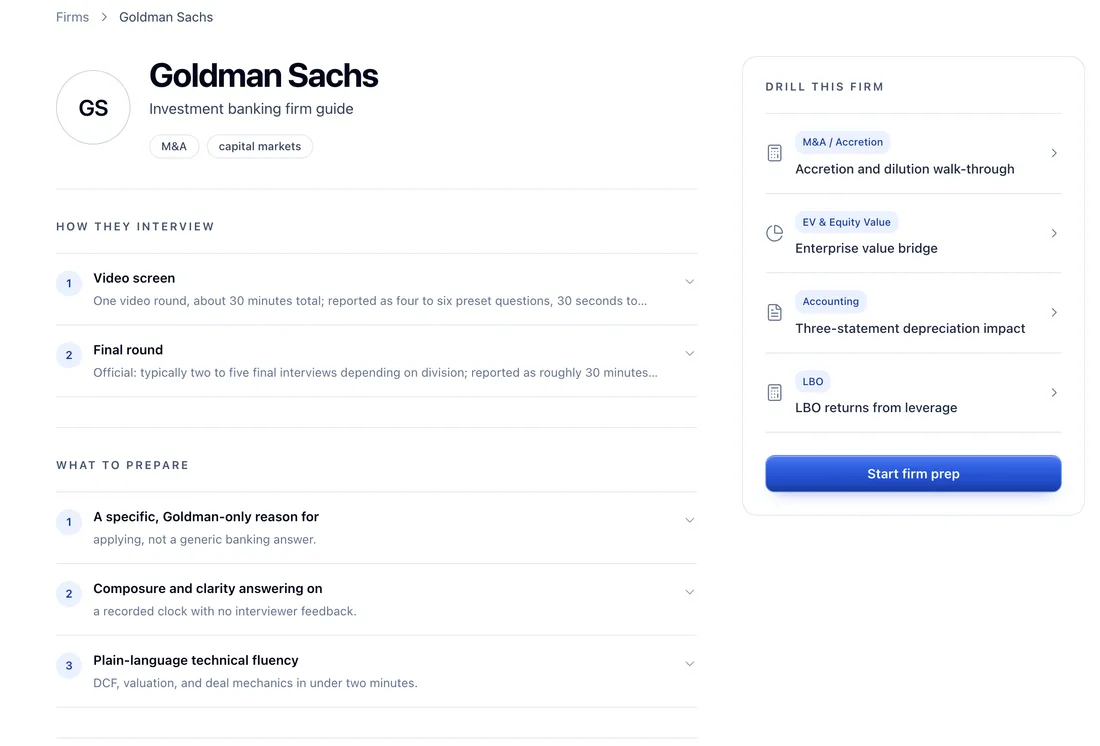
Run a Goldman Sachs question
Practice Goldman Sachs questionsFree account, no card.
Prepare the rest of the loop
Goldman Sachs interview questions run through a process the firm publishes itself: an online application, a first interview by video of approximately 30 minutes, and a final round the firm labels Superday, typically two to five interviews for campus hires depending on division (official, checked September 2026). Goldman does not publish its prompts, per-answer timing, retake policy, or a technical-to-behavioral split, so every question below is original practice, not a leaked script. The firm's own advice shapes the prep: because the same skills may translate across divisions, learn about all of its opportunities before you decide where to apply. This guide covers the published process, what the video stage tests, the technical core to prepare, and how to answer "why Goldman Sachs" at division level.
TL;DR
- The first interview is a video interview of approximately 30 minutes; engineering applicants take a HackerRank assessment instead (official).
- Finalists reach a Superday: typically two to five interviews for campus hires, varying by division (official).
- Goldman evaluates applications throughout the recruiting season, so you may hear back about different roles at different times.
- Prompts, per-answer timers, retake policy, and technical weighting are not published; candidate reports describe a video screen weighted toward motivation and fit (reported).
- Six try-first reps below cover behavioral, accounting, comps, DCF, M&A, and estimation, followed by two drill sets with one free rep each.
What does Goldman Sachs publish about its process?
The student preparation page lays out six steps: plan your timeline, choose your path, connect with the firm at events, submit your application, complete a first interview, and finish at a Superday. Applications are evaluated throughout the recruiting season, and the firm commits to confirming receipt shortly after you apply, updating you later in the season, and closing the loop at the end.
| Stage (official) | Format | What the firm says | Your prep move |
|---|---|---|---|
| Application | Online, through the student careers portal | The same skills may translate to multiple divisions; learn about all opportunities before deciding | Pick a division you can defend, not a brand |
| First interview | Video interview, approximately 30 minutes | Engineering applicants take a HackerRank assessment | Rehearse spoken answers on camera, timed |
| Superday | Series of final-round interviews | Typically two to five interviews for campus hires depending on division; expect to meet a cross-section of people you could work with | Build one consistent evidence set every interviewer can probe |
| Published by the firm | Not published |
|---|---|
| Video first interview of about 30 minutes, HackerRank for engineering | Exact prompts or question counts |
| Two-to-five-interview Superday range for campus hires | Per-answer timing or retake policy |
| Rolling evaluation through the recruiting season | A technical-to-behavioral weighting |
| Divisions grouped under Global Banking and Markets, Asset and Wealth Management, and Platform Solutions | Whether your final round is virtual or in person |
Start from the official steps, then build around them. The Goldman Sachs firm guide carries the process detail and practice bank, and the investment banking superday guide shows how a final-round day is usually structured across banks.
Preparation map
Three steps before your interview
Step 1
Check the invitation
Format and deadline
Use your programme instructions
Step 2
Prepare your evidence
Motivation and experience
Explain your own contribution
Step 3
Practise follow-ups
Role-relevant reasoning
Test a changed assumption
What does the video interview actually test?
Officially, the video interview is the first interview after application selection and takes approximately 30 minutes to complete. HireVue's own candidate FAQ, which describes the platform rather than Goldman specifically, says most video-based assessments include between five and eight questions and take under 20 to 30 minutes, with question types that include past-behavior, situational judgement, and scenario prompts (platform guidance, not firm policy).
Candidate reports describe Goldman's video screen as weighted toward motivation and fit: why Goldman, why this division, a resume walk-through, and teamwork evidence, with occasional markets or light technical questions depending on division (reported, not official). Because no person sits across from you, delivery carries more weight than in a live screen. Record yourself answering in two to three minute blocks, watch for rambling, and treat the camera as the interviewer.
Three habits matter more than clever content at this stage:
- Answer the motivation prompts with division-level specifics, since the firm asks you to choose a path before you apply.
- Keep each answer inside a tight structure: claim, evidence, result, in roughly two minutes.
- Rehearse on camera, not in your head; pacing and eye line only improve with recorded reps.
The investment banking HireVue guide covers setup and structure, and the banking HireVue questions guide gives recorded-format answer frameworks.
Which divisions should you research before applying?
Goldman groups its client businesses under Global Banking and Markets, which includes Investment Banking, FICC and Equities, Marquee, and Transaction Banking, plus Asset and Wealth Management and Platform Solutions (official, checked September 2026). The firm tells applicants to learn about all of its opportunities because the same skills may translate to multiple divisions, which makes "why this division" a question you cannot dodge.
For investment banking applicants, that means knowing how the division itself is organized: coverage teams own the client relationship by industry, while product teams own the transaction type, such as M&A or financing. The coverage versus product groups guide explains the split. A defensible answer names a group, the work it does, and why your evidence points there.
What Goldman Sachs-style questions should you practice?
These are original IB Offer exercises modeled on the skills the process screens for, not reported Goldman prompts. Write your attempt in each card; the model answer and AI grading unlock with a free account.
Behavioral and fit
The video screen and Superday both lean on reusable evidence, so build a story bank before drilling technicals. The strongest stories name who relied on your work and what changed because of it.
Behavioral · try it first
Tell me about a time you took ownership of a project that a team depended on.
Build the full evidence bank with the investment banking behavioral interview questions guide, then rehearse each story aloud until the two-minute version is natural.
Accounting and the three statements
Three-statement mechanics are the floor of every technical screen: you should be able to trace one change through all three statements without notes.
Accounting · try it first
Walk me through how a 30 dollar increase in accounts receivable flows through the three financial statements.
Refresh the mechanics in the three financial statements linked guide, then try a graded rep on the accounting practice page.
Valuation and comparable companies
Expect to defend a multiple, not just compute one.
Valuation · try it first
Why might two companies in the same sector trade at different EV/EBITDA multiples?
The comparable company analysis guide covers peer selection and the pitfalls a skewed comp set creates.
DCF
Expect to explain why a DCF moves, not just how to build one.
DCF · try it first
Walk me through a DCF, from unlevered free cash flow to an implied share price.
The full framework is in the walk me through a DCF guide, and the DCF practice page grades a rep.
M&A and deal judgment
M&A · try it first
An acquirer with a higher P/E than its target completes an all-stock deal at a modest premium. Is the deal likely accretive or dilutive, and why?
For the version interviewers actually ask, the how to discuss a deal guide shows how to talk through a live transaction in two minutes.
Markets and estimation
Candidate reports mention occasional market-sizing or estimation questions on the video screen (reported, not official). The interviewer grades structure, not the final figure.
Mental Math · try it first
Estimate the number of gas stations in a mid-sized US city.
Drill sets: valuation and DCF reps
One free rep each, matched to the technical core above. Finish a rep and the prompt to keep practicing appears.
Practice inside this guide
Valuation multiples practice
Question 1 of 1
Two companies have similar revenue but trade at different EV/EBITDA multiples. What explains the gap?
Practice inside this guide
DCF interview practice
Question 1 of 1
Why does a DCF discount unlevered free cash flow at WACC rather than at the cost of equity?
How do you answer "why Goldman Sachs"?
Use three moves: one division-level reason, one piece of verified evidence, and one personal connection. Name the group and the work it does, explain how you tested the interest through a deal you studied, an event you attended, or a banker you spoke with, and connect it to your experience. Goldman describes its culture as apprenticeship and learning by doing, so evidence that you sought out real exposure lands better than prestige claims.
A practical worksheet has four lines:
- The Goldman division and group that interest me are...
- I verified that interest through...
- My relevant evidence is...
- The contribution I want to make is...
Now run the swap test: replace Goldman Sachs with another bulge-bracket name. If the answer still works, research further. Avoid inventing rankings, deal roles, or culture facts you cannot source. The full method is in how to answer why this bank.
Frequently Asked Questions
Does Goldman Sachs publish its exact interview questions?
No. The official preparation page describes the stages but publishes no prompt list, question count, per-answer timer, or retake policy (checked September 2026). Treat any specific question list online as a practice model, not a leaked script.
How long is the Goldman Sachs video interview?
Approximately 30 minutes in total, covering the whole interview rather than each answer (official). HireVue's platform FAQ notes most video assessments take under 20 to 30 minutes, but Goldman's own 30-minute description is the figure to plan around.
How many final-round interviews should I expect?
The firm says it typically conducts between two and five interviews for campus hires, depending on the division, at a final round it calls Superday (official). Your own invitation is authoritative for your process.
Is the Goldman Sachs process mostly behavioral or mostly technical?
The firm publishes no ratio. Candidate reports describe the video screen as weighted toward motivation and fit, with deeper technical questions appearing in division-specific final rounds (reported). Prepare both: a reusable behavioral evidence bank plus the accounting, valuation, and DCF core.
Do engineering applicants go through the same interviews?
No. The official page states engineering applicants are asked to take a HackerRank coding assessment instead of the video interview.
When should I apply to Goldman Sachs?
The student site lists exploratory programs, internships, full-time roles, and graduate programs, and notes applications are evaluated throughout the recruiting season, which means you may hear back about different roles at different times. Apply as early as your target program's posting allows, and check the student portal for the current window rather than relying on third-party timelines.
Are the questions in this guide real leaked Goldman Sachs questions?
No. They are original IB Offer practice exercises built on the skills the published process screens for. Our Goldman-tagged question bank holds 19 practice questions across behavioral fit, comps, DCF, LBO, enterprise value, M&A, brain teasers, and accounting.
Sources
- Goldman Sachs: Students (official, checked September 2026)
- Goldman Sachs: Prepare (official, checked September 2026)
- HireVue Candidate FAQ (platform guidance, checked September 2026)
Free interview path
Get your Goldman Sachs interview plan
- Step 1Why TMT or FIG specifically?Behavioral questions · Advanced
- Step 22 valuation multiples questions
- Step 31 three-statement question
- Step 41 enterprise value bridge question
+14 more questions in the Goldman Sachs bank after these steps.
Get my free Goldman Sachs planFree, no card. 5 AI-graded reps a day for 3 days from your first rep.