LBO Model Explained: Structure and Returns
How an LBO model works: sources and uses, the debt schedule, cash generation, and the three drivers of private equity returns, with a worked example.
On this page
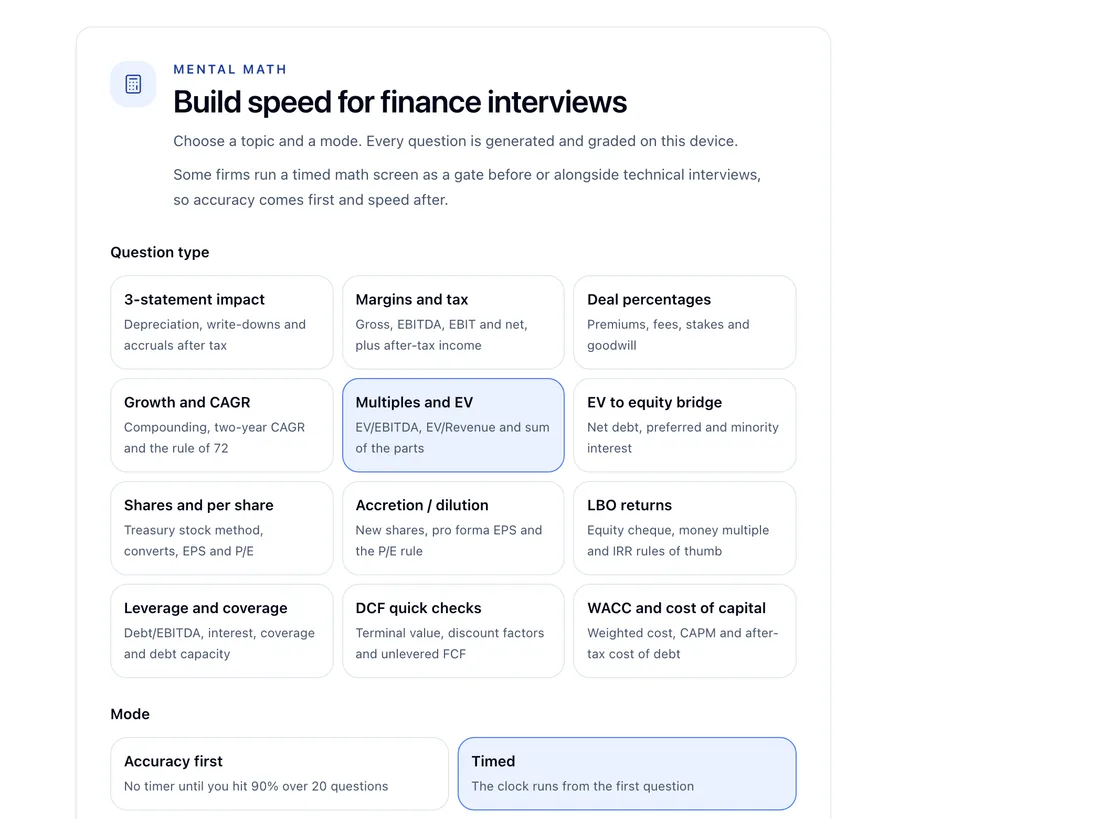
3 timed LBO return questions
Start the timed setAbout 2 minutes. Free account, no card.
Round out your prep
An LBO model values a company the way a private equity buyer sees it: purchase the business mostly with debt, run it while the cash flow pays that debt down, and sell it years later. The sponsor's return comes from the equity check growing as leverage shrinks. The model has three moving parts: a sources and uses table that sets the entry capital structure, a debt schedule that tracks paydown against cash flow, and an exit calculation that prices the equity at the end. Returns come from three drivers: EBITDA growth, debt paydown, and multiple expansion; only the last one is out of the sponsor's hands. This guide explains the model's anatomy; for the timed interview version see how to solve a paper LBO.
TL;DR
- An LBO model has three blocks: sources and uses at entry, a cash-flow-fed debt schedule in the middle, and an exit valuation at the end.
- Returns come from EBITDA growth, deleveraging, and multiple expansion, with deleveraging typically doing does the most reliable work.
- Leverage amplifies equity returns both directions: that is the entire reason the structure exists, and its main risk.
- A good LBO candidate has stable cash flow, low capital intensity, and a defensible market position.
- Interviewers test the mental math first; the paper LBO format is the standard assessment.
What is an LBO model?
An LBO model is a leveraged buyout projection: it assumes a financial sponsor acquires a company using a large amount of debt plus a smaller equity check, then measures what that equity is worth at a future exit. The model exists to answer one question: does the deal generate an acceptable return for the sponsor, typically expressed as IRR and MOIC. Breaking Into Wall Street describes the core mechanic as using the company's own cash flows to repay the acquisition debt, so the sponsor's profit comes from owning an ever-larger slice of the same business.
Unlike a DCF model, an LBO model does not produce a standalone valuation; it produces a return for a given entry price, which is why bankers also run it backward to find the maximum price a sponsor could pay.
How does the sources and uses table work?
The entry point of every LBO model is the sources and uses table: uses are the purchase price, refinanced debt, and transaction fees; sources are the new debt tranches plus the sponsor's equity check. The split between debt and equity is set by leverage capacity (lenders underwrite to a multiple of EBITDA) and the equity check is whatever plugs the gap. A typical structure layers senior debt first (cheapest, tightest covenants), then junior layers like high-yield bonds or unitranche facilities. The tranche-by-tranche anatomy lives in LBO capital structure and debt tranches.
How does the debt schedule drive the model?
The middle of the model is a five-to-seven-year projection where free cash flow each year goes to debt paydown, often through a mandatory amortization schedule plus a cash flow sweep that applies excess cash to the principal. As the debt balance falls, interest expense falls, which frees more cash for the next paydown, a compounding mechanic that is the engine of the whole deal. The schedule tracks each tranche separately because they carry different rates, amortization, and callability.
LBO · try it first
A sponsor buys a company for 500 million dollars using 300 of debt and 200 of equity. EBITDA is 80 at entry and 100 at exit five years later; the exit multiple is unchanged at 6.25x. Debt is fully repaid. What is the MOIC?
What are the three drivers of LBO returns?
Every LBO return decomposes into the same three components, and interviewers expect you to name and rank them:
| Driver | Mechanism | Sponsor control |
|---|---|---|
| EBITDA growth | Operating improvements, add-on acquisitions | High: the operating plan |
| Debt paydown | Free cash flow retires principal | High: cash conversion |
| Multiple expansion | Exit multiple exceeds entry multiple | None: market conditions |
The conservative underwriting rule is to assume a flat or contracting exit multiple and make the deal work on the first two drivers alone. If the model only clears the return hurdle with multiple expansion, the deal is a market bet, not an operating bet. For deeper practice on the return math, see IRR vs MOIC.
What makes a company a good LBO candidate?
The model only works if the cash flow can carry the debt. Strong candidates share stable and predictable revenue (defensible contracts, recurring demand), low capital intensity so earnings convert to cash, a durable market position that survives a leveraged balance sheet, and a purchase price that leaves headroom under the leverage ceiling. Cyclical or capital-hungry businesses fail the first test regardless of price. This candidate screen is also the standard answer to "what do you look for in an LBO"; the interview walkthrough lives in walk me through an LBO.
How does the exit math close the model?
At exit the model applies an exit multiple (usually EV/EBITDA) to final-year EBITDA for the exit enterprise value, subtracts remaining debt, and what is left is the sponsor's equity proceeds. IRR and MOIC compare that to the original check. The spreadsheet version also layers in management rollover, earnouts, and dividend recaps along the way, but the core loop never changes: buy with leverage, convert cash flow to equity value, exit. Try the mechanics on the practice set below: the reps are the same arithmetic interviewers put on a whiteboard.
Quick Math
- A sponsor buys a company for $500 million of enterprise value and funds it with $300 million of debt. What is the equity cheque, in millions?
Equity cheque = purchase EV − debt raised.
- The deal carries $300 million of debt at a 7% rate. What is annual interest expense, in millions?
Interest = debt × rate. Do that one first.
- The $200 million equity cheque returns $500 million at exit. What is the money multiple?
Money multiple = exit equity ÷ entry equity.
Frequently Asked Questions
What does LBO stand for and what is an LBO model?
LBO stands for leveraged buyout, acquiring a company primarily with borrowed money. An LBO model is the projection a sponsor builds to test whether the deal generates an acceptable equity return, tracking entry structure, debt paydown, and exit value.
What is a good IRR or MOIC for an LBO?
Private equity underwriting typically targets around a 20 percent IRR or a 2x-plus MOIC over a roughly five-year hold, though hurdle rates vary by fund. The checks pair: a 2x MOIC in five years is roughly a 15 percent IRR, so both get quoted together.
Why do sponsors use debt instead of all equity?
Leverage amplifies the equity return: the company's cash flow retires fixed-rate debt while the sponsor's smaller equity check absorbs the upside. The same amplifier works in reverse: a business that misses its plan can wipe out thin equity quickly, which is why leverage capacity is the binding constraint.
What is a cash sweep in an LBO model?
A cash sweep is a provision that forces excess free cash flow (after mandatory amortization) to pay down additional debt principal automatically. It accelerates deleveraging and is modeled as a switch on the debt schedule. Details in cash flow sweep in an LBO.
How is an LBO model different from a DCF?
A DCF produces an intrinsic value by discounting unlevered cash flows at WACC. An LBO model produces a return on the sponsor's equity given a specific price and capital structure. It answers "can a financial buyer make money at this price," not "what is the company worth."
Sources
- Breaking Into Wall Street, "LBO Models and Interview Questions": https://breakingintowallstreet.com/kb/leveraged-buyouts-and-lbo-models/lbo-interview-questions/ (checked September 2026)
- Financial Edge, "Walk Me Through an LBO Model": https://www.fe.training/free-resources/lbo/walk-me-through-an-lbo-model-interview-question/ (checked September 2026)
- Transacted, "Walk Me Through an LBO": https://www.transacted.io/walk-me-through-an-lbo (checked September 2026)
- Lumovest, "Walk Me Through an LBO Model": https://www.lumovest.com/library/investment-banking-interview-questions/walk-me-through-an-lbo-model/ (checked September 2026)
LBO practice
Practise LBO with a real grade
Take one LBO question, write the answer you would give out loud, and get a real score on it before an interviewer does.
Free, no card. 5 AI-graded reps a day for 3 days from your first rep.